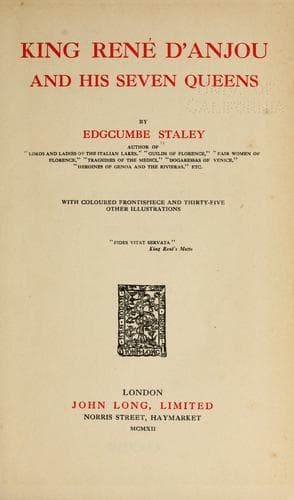
King René d'Anjou and His Seven QueensStaley, Edgcumbe
History
King René d'Anjou and His Seven Queens
Staley, Edgcumbe
France -- Court and courtiers; René I, King of Naples and Jerusalem, 1409-1480
Over the anticlimax of the feast the kindly chroniclers usually draw a
discreet veil, for warriors in the field were vanquished in the hall,
and beauties beloved in the boudoir were forgotten in the debauch.
We may suppose rightfully, however, that the hospitalities of René
and Jehanne never caused a flush of shame or a prick of scorn. They
aimed at and happily succeeded in proving that “_il n’y pas au monde
de royauté comparable au bonheur d’être aimé d’elle_,” as the King
prettily termed it.
For twenty-five years the simple delights of a useful domestic life
were serenely enjoyed by the happy King and Queen. Their spirit of
contentedness hallowed the homes of their people, and Provence became
a paradise of peace. Certainly the want of children caused Jehanne
many a pang, but the devotion of a good husband, one so accomplished,
so unselfish, and so universally beloved, was a real compensation,
and she had learned the lesson of mingled weal and woe. She found
congenial occupation in furthering the good intentions of the King
and in ministering to all in need around her. She had, nevertheless,
quasi-maternal cares, for in the palace at Aix and in other royal
residences were several children and young people of both sexes,
besides the three acknowledged bastards by convention, who could lay
claim to royal parentage. Some of these are mentioned in _Les Comptes_
as receiving alimony and gifts from René. An entry on July 8, 1466,
records the gift to Demoiselle Odille of a pelisse of marten fur.
She was then somewhere about twenty years of age, but had charge of
the King’s rings and jewellery under the eye of Sieur Guillaume de
Remerville, the Treasurer of the Household. René had married her, in
1460, to Gaspare Spinola, a Genoese attendant in his train, who died
in 1465, leaving his child-widow to the care of her father. Another
child is also named, Hélène,--“_la petite Hélène_,” as René called
her,--an attractive little creature, “singing like a lark and dancing
like a gazelle,” who died on her fifteenth birthday, in the year 1469.
The King liked to have her near him at meal-times, when he fondled her
affectionately, “_comme ma vraie fille_.”
Public-domain text, read in full here on John Shaqi.
Reviews
Reviews
No reviews yet
Be the first to share your thoughts on this work.
Elsewhere in the archive
Join the Discussion
Join the discussion
Sign in to leave a comment or review.
Sign InorCreate an account