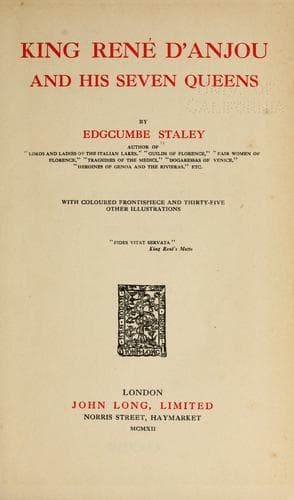
King René d'Anjou and His Seven QueensStaley, Edgcumbe
History
King René d'Anjou and His Seven Queens
Staley, Edgcumbe
France -- Court and courtiers; René I, King of Naples and Jerusalem, 1409-1480
King René in his will speaks thus of his beloved Queen: “Because
Jehanne has loved me, so I do and shall love her as my dearest wife
till death. Her virtues and her goodness to me I cannot forget, nor her
loving services which she has rendered me for so long a time. I will
that she shall have unrestricted liberty of action to settle, when I
am dead, where she will.… I give to her the county of Beaufort; the
castle and estate of Mirabeau; the town of Aubagne; the castles of San
Remy, Pertuis, and Les Baux, with my _bastides_ in and about Aix and at
Marseilles, with all their furniture and appurtenances.” King René also
specially bequeathed to Jehanne his most valuable jewels: collars of
diamonds; “_le grand et le petit bulay_,” rubies, with sprays of gold
and gems;[A] his diamonds “_à la cesse_,” uncut and strung (?); his
plates and caskets of gold; his great bowls of gold; his great trays of
silver; and his precious goblet and ewer of gold encrusted with jewels;
and many other splendid precious objects.
[A] “_Le grand bulay_” was a famous ruby, richly mounted, which
he had bought for 18,000 florins (= £7,000).
With respect to the body of King René, it has been chronicled that the
Queen before leaving Aix made secret arrangements for its translation
to Angers. She feared a hostile demonstration if open measures were
taken. She took into her confidence a priest belonging to the cathedral
chapter, and they together worked out a plan which was put into
operation after Queen Jehanne had arrived at Angers. She sent two of
her most trusty attendants, Jehan de Pastis and Jacquemain de Mahiers,
with an imposing suite, conveying a letter to the Archbishop of Aix
asking for the heart of René. The priestly confidant was at the service
of the envoys, and they very cleverly contrived to secrete the casket
with the King’s body in a royal chariot which the Queen had commanded
to be laden with certain dresses and properties she had left behind,
and in particular the pall she had worked with her own hand, and which
was still covering the dead King’s coffin. The precious burden was
driven to a secluded backwater of the Rhone, and there embarked upon a
great royal barge; and so King René’s body passed through France once
more, as he had so often done in life. The disembarkment of the royal
corpse was effected at Ponts-de-Cé, across the Loire, a few miles out
of Angers, and thence the second obsequies were conducted with splendid
ceremonies and amid universal tokens of joy and sorrow of his Angevine
subjects. The heart was with the body, but the entrails were left at
Aix in the cathedral.
Public-domain text, read in full here on John Shaqi.
Reviews
Reviews
No reviews yet
Be the first to share your thoughts on this work.
Elsewhere in the archive
Join the Discussion
Join the discussion
Sign in to leave a comment or review.
Sign InorCreate an account