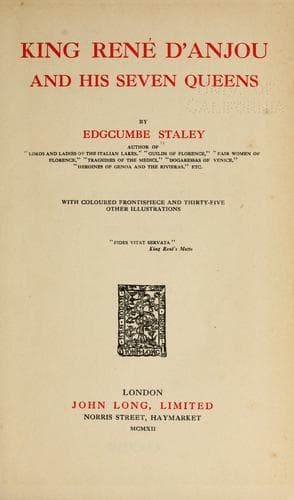
King René d'Anjou and His Seven QueensStaley, Edgcumbe
History
King René d'Anjou and His Seven Queens
Staley, Edgcumbe
France -- Court and courtiers; René I, King of Naples and Jerusalem, 1409-1480
This was the last public appearance of Queen Jehanne. She retired
to her Castle of Beaufort, and there she spent the residue of her
life, eighteen long and solitary years--years never idle, never
self-indulgent, years loyal to the fond memory of her spouse, years
yearning for reunion. The day Jehanne entered her new home was St.
Luke’s festival, 1481, the second summer of the year, when the last
grapes hang ripened upon the vines, and the year’s vintage is gathered
in. Perhaps the simile from Nature enforced itself upon the widowed
Queen’s sympathetic mind. Her harvest was now that of the quiet
eye; its growth had been when eye met eye--hers and René’s; now was
approaching the winter of her life, when her work was to be finished
and her rest full-garnered.
Jehanne chose as the companions of her widowhood three trusty
servitors--René de Breslay, her Seneschal; Thibault de Cossé, her
Master of the Household; and Bernard de Praneas, her Confessor. She
spent her time in prayer and charity. She established hostels for poor
people, for pilgrims and the sick; schools for children left orphans,
and for those cast upon the world by miserable parents. Besides these
pious works, the good Queen preserved her interest in such arts and
crafts as she and René had encouraged in Provence. She studied once
more books and sciences he had loved, she painted miniatures, composed
madrigals and hymns, and sang and played as she had done for him, and
her pen became that of the ready writer. She translated Guillaume de
Guillerville’s tragedy, “The Pilgrimage of Human Life”; “The Soul
separated from the Body,” a poem by Jehan Galoppez, a priest of Angers
and her Private Secretary; and a moralization upon “The Certainty of
Paradise.” All her works were, however, in prose, which, she said
“_conservez le sens et les images, mais déliverez moi du martelage et
des grimaces de ce baragouin!_”[A]
[A] “Preserve the sense and the shape, but protect me from
forced metaphor and gibberish!”
Perhaps the action which most endeared the memory of the good Queen
to the hearts and minds of the people about her was the extraordinary
pains she took to alleviate taxation and to readjust tribute. When René
took over the estate in 1471, he made vast reductions in the imposts
on land and stock and crop. These were confirmed by Queen Jehanne ten
years later, and further reductions were conceded. Her plea to herself
was: “Now René is no more, I have no other rôle to play but to do as he
would have wished me.” The Forest of Beaufort, where René and she had
followed the chase in princely fashion, now no longer echoed the blast
of hunting-horns and the cracks of hunting-whips, but with the gentle
notes of the _Angelus_, and when the curfews rang out in neighbouring
village and homestead, they carried with them the refrain, “_Priez pour
la bonne Jehanne_.”
Public-domain text, read in full here on John Shaqi.
Reviews
Reviews
No reviews yet
Be the first to share your thoughts on this work.
Elsewhere in the archive
Join the Discussion
Join the discussion
Sign in to leave a comment or review.
Sign InorCreate an account