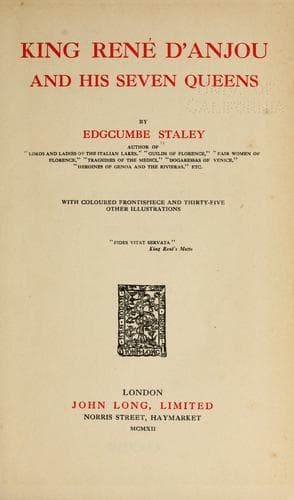
King René d'Anjou and His Seven Queens — John Shaqi
King René d'Anjou and His Seven QueensStaley, Edgcumbe
History
King René d'Anjou and His Seven Queens
Staley, Edgcumbe
France -- Court and courtiers; René I, King of Naples and Jerusalem, 1409-1480
No better choice could have been made from a psychological point of
view, for have not the Arlésiennes been noted for all time for their
perfect figures,--Venus di Milo was one of them,--their graceful
carriage, and surpassingly good looks? They, with their menfolk,
animated and merry, have always eaten well and well drunk. The
delicious pink St. Peray is a more generous wine than all the vintages
of Champagne. Physical charms and _fin bouquets_ were ever incentives
to love and pleasure, and Mars of Aragon yielded up his arms to Venus
of Arles. _Arles--la belle Grecque aux yeux Sarrazines!_ Perhaps the
becoming, close-fitting black velvet _chapelles_, or bonnets, and the
diaphanous white gauze veils, did much to express _la grâce fière aux
femmes_!
It was indeed a gorgeous function at which the royal couple were
united in the bonds of matrimony, that morrow of All Saints, 1399. The
ancient basilica of St. Trophimus was one vast nave, no choir,--that
the royal brothers Louis and René built a generation later,--but it was
too circumscribed for the marriage ritual; consequently, under a gold
and crimson awning, slung on ships’ masts beyond the deeply recessed
chief portal, with its weird sculptures, the clergy took up their
station to await the bridal pageant. The Cardinal-Archbishop, Nicholas
de Brancas, joined the two young hands in wedlock, and Cardinal Adreano
Savernelli, the Papal Legate, gave the blessing of Peter, whilst the
two mother-Queens looked on approvingly.
The royal bride,--in white, of course,--had an over-kirtle, or train,
of gemmed silver tissue--a thing of wonderment and beauty worn by her
royal mother, and her mother, Marie de France, before her, and coming
from the Greco-Flemish trousseau of the famous Countess Iolande. Her
abundant brown-black hair was plaited in two thick ropes, with pearls
and silver lace reaching far below the jewelled golden cincture that
encompassed her well-formed bust. Upon her thinly covered bosom reposed
the kingly medallion of her father, King Juan, with its massive golden
chain of Estate, the emblem of her sovereign rank. Upon her finger she
wore the simple ruby ring of betrothal, now to be exchanged for the
plain golden hoop of marriage.
Public-domain text, read in full here on John Shaqi.
Reviews
Reviews
No reviews yet
Be the first to share your thoughts on this work.
Join the Discussion
Join the discussion
Sign in to leave a comment or review.
Sign InorCreate an account