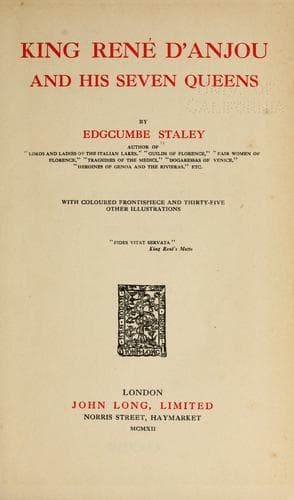
King René d'Anjou and His Seven QueensStaley, Edgcumbe
History
King René d'Anjou and His Seven Queens
Staley, Edgcumbe
France -- Court and courtiers; René I, King of Naples and Jerusalem, 1409-1480
The year 1404 had seasons of peculiar sorrow for the Angevine
Court, followed, happily, by joyous days. On May 19 the King-Duke’s
brother, Charles, Duke of Maine and Count of Guise, died suddenly at
Angers,--the “Black Death” they called his malady,--amid universal
regret. He had been content to play a subordinate rôle in the affairs
of State--a man more addicted to scholarly pursuits than political
activities. He had, however, proved himself the son of a good mother
and the stay of his young sister-in-law from Aragon during her spouse’s
absence from his own dominions. The Duke left one only child--a
boy--who succeeded him as Charles II. of Maine. Queen-Duchess Marie
felt her dear son’s untimely death acutely, and, notwithstanding the
loving care of her devoted daughter-in-law, she never recovered from
the prostration of her grief. Within a fortnight of the obsequies of
her son, the feet of those who had so sorrowfully borne his body forth
to burial were treading the same mournful path, tenderly bearing her
own funeral casket.
Ever since her happy marriage to Louis I. in 1360, Marie de
Châtillon-Blois had borne nobly her part as the worthy helpmeet of her
spouse and the devoted mother of his children. For ten years after his
death her gentle presence and wise counsels had directed the affairs of
the House of Sicily-Anjou, and smoothed away all difficulties from the
path of her son. She left immense wealth, which, added to the goodly
fortune of Louis I., made her son the richest Sovereign in all France.
It was said at the time that she was worth “more than twenty-two
millions of livres.” “In spite of reputed avarice and hoarding,“ said
a not too friendly historian, ”she was a sapient ruler, moderate and
firm, and she left Anjou the better for a good example.” “_Sachiez_,”
wrote Bourdigne of her, “_que c’estoit une dame de goût faiet, et
de moult grant ponchas, car point ne dormoit en poursuivant ses
besoignes_.”
These dark clouds hung heavily over Louis II. and Yolande, but the
cause of their passing was a signal of enthusiastic joy. On October 14
a little baby-girl was born. Mary, the “Mother of Sorrows,” heard the
prayer of the stricken Royal Family, and sent a new Mary to fill the
place of the lamented Duchess; for the child was named Marie simply,
and was offered to St. Mary for her own.
Public-domain text, read in full here on John Shaqi.
Reviews
Reviews
No reviews yet
Be the first to share your thoughts on this work.
Join the Discussion
Join the discussion
Sign in to leave a comment or review.
Sign InorCreate an account