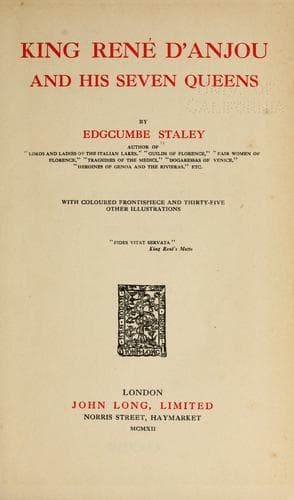
King René d'Anjou and His Seven QueensStaley, Edgcumbe
History
King René d'Anjou and His Seven Queens
Staley, Edgcumbe
France -- Court and courtiers; René I, King of Naples and Jerusalem, 1409-1480
Again the mirthful pursuits of the Court and country were stayed by
the stringency of the times. Sedition spread its baneful influence all
over Provence and Languedoc what time King Louis was still far away
fighting in Italy. With courage, fraught with love and assurance, she
set off to the distant province, taking with her, not only an escort
of doughty war-lords, but also her own tender nurslings--Louis, Marie,
and René. With her children was also the young Princess Catherine,
daughter of Jean “sans Peur,” the Duke of Burgundy, whose betrothal
to her eldest son Louis was imminent. Through his children her appeal
would first be made to her husband’s disaffected subjects. Should
that fail, then she could don cuirass and casque and head her royal
troops to worst them. With little Vicomte d’Aix upon her saddle-lap,
she passed through village, town, and city, receiving enthusiastic
plaudits everywhere; she was “_Madame la Nostre Royne_!” The head of
the rebellion was scotched, and from Aix the intrepid Queen despatched
messengers to the King to tell of her success, and to say that she was
ready to embark at once to his assistance.
This heroic offer was made possible by the death of King Martin of
Aragon in 1410, who bequeathed to his niece the whole of his private
fortune. This event, however, added to the Queen’s anxieties, for
she was not the sort of woman to allow the royal succession to pass
for ever unchallenged. _La Justicia Mayor_ of the State of Aragon
assembled at the ancient royal castle of Alcañiz to receive the names
and to adjudicate the claims of candidates for the vacant throne.
Yolande, still styling herself “Queen of Aragon,” was represented by
Louis, Duke of Bourbon, and Antoine, Count of Vendôme. Her claim was
not immediately for herself, but for her son Louis. Two years were
spent in acrimonious deliberations, but the provisions of the Salic
Law penalized the female descent, and consequently the next male heir,
Prince Ferdinand of Castile, placed the crown of Aragon upon his head
as well as that of Castile. Queen Yolande had to be content with her
protest and her titular sovereignty.
Back at Angers in 1413, the Queen conceived a notable future for her
nine-years-old daughter, Marie. Of the six sons of Charles VI. of
France and Isabeau, only one survived, the fifth-born, Charles. The
imperious Bavarian Queen had little or none of Queen Yolande’s fondness
for her offspring; they were born, alas! put out to nurse, forgotten,
and neglected--so they died. Upon the little Prince--the cherished
jewel of his father--Queen Yolande fixed her motherly regard. He was
a year older than her Marie, and a piteous little object bereft of a
mother’s love and solicitude. Yolande’s warm heart yearned towards the
lonely child; she would mother him, she would train him, and then she
would marry him to Marie--this was the Queen’s dream.
Public-domain text, read in full here on John Shaqi.
Reviews
Reviews
No reviews yet
Be the first to share your thoughts on this work.
Join the Discussion
Join the discussion
Sign in to leave a comment or review.
Sign InorCreate an account