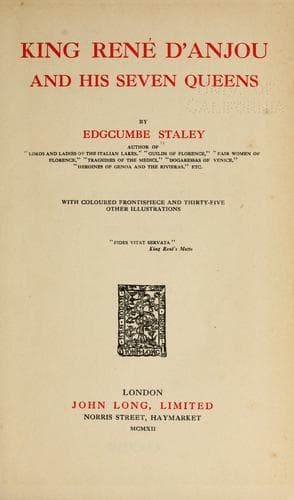
King René d'Anjou and His Seven QueensStaley, Edgcumbe
History
King René d'Anjou and His Seven Queens
Staley, Edgcumbe
France -- Court and courtiers; René I, King of Naples and Jerusalem, 1409-1480
Cast down by grief unspeakable, the young
Queen of Sicily-Anjou and Naples, Margherita, still a bride, was by
his side to console his last hours. They had been married by proxy at
Geneva,--not at Chambéry, as arranged,--years before, but had sworn to
each other recently in the Cathedral of Cosenza. Alas! no son was left
to succeed his father and cheer his mother’s heart; their only child, a
little daughter, had survived her birth a short six weeks.
Queen Giovanna, in spite of her iniquity in seeking to foist upon
René d’Anjou and Bar a child not his nor hers, in all probability, but
so acknowledged, made no opposition to his proclamation as King of
Naples or the Two Sicilies. What an exquisite piece of irony it was, to
be sure--a King proclaimed when fast bound in prison, a crayon for a
sceptre in his hand, his crown a drab _berretta_! Three devoted women,
good and bad, supported the royal captive’s prerogatives--three Queens
indeed: Yolande was for Anjou and Provence, Isabelle for Barrois and
Lorraine, and Giovanna for Naples and Sicily; whilst a fourth, Queen
Margherita, looked to the donjon of Dijon for clemency. It was said
that a copy of King René’s proclamation was fixed upon the portal of
his prison in insolent derision. “_Sic transit gloria mundi_” might
well have been penned beneath it.
Upon King René’s succession to the throne of Sicily-Anjou, Queen
Yolande continued to act as his Lieutenant-General for Anjou and
Provence, and left negotiations for his release to the young
Queen-Duchess Isabelle, who was very much more favourably placed, and
near at hand to serve the royal prisoner’s interests. She spent most of
her time in Anjou, but paid many visits to Marseilles, her favourite
residence in Provence. She never crossed the Aragonese frontier;
she could have done so only as Queen-regnant, which of course was
impossible. However, she named her grandson Jean, Duke of Calabria,
King René’s eldest son, as the heir to her ancestral claims.
Public-domain text, read in full here on John Shaqi.
Reviews
Reviews
No reviews yet
Be the first to share your thoughts on this work.
Elsewhere in the archive
Join the Discussion
Join the discussion
Sign in to leave a comment or review.
Sign InorCreate an account