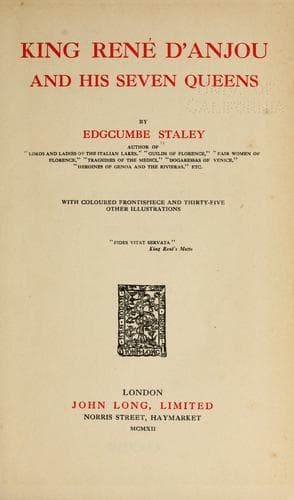
King René d'Anjou and His Seven QueensStaley, Edgcumbe
History
King René d'Anjou and His Seven Queens
Staley, Edgcumbe
France -- Court and courtiers; René I, King of Naples and Jerusalem, 1409-1480
The Queen-mother’s presence in Anjou was necessary in the interests of
her daughter, Queen Marie of France, and she never relaxed her control
of the policy of her royal son-in-law. At each accouchement of the
French Queen her devoted mother assisted, and it was a long family of
grandchildren she nursed upon her knee. Her succour in sickness, her
stay in trouble, and her help in poverty, were immeasurably precious
to the fugitive Sovereigns. In 1437 Queen Yolande had the felicity
also of receiving her son René, after his release from durance vile,
in the Castle of Tine, near Saumur, and with him came Queen Isabelle
and her children,--Prince Jean, the eldest, being a fine lad of eleven.
It was a season of universal rejoicing in Anjou, and the Queen-mother,
laying aside her widow’s _chapelle_ and veil, entered whole-heartedly
into the festivities. The most cheering feature of the gaiety was due
to the magnanimity of the Duke of Burgundy, who quite unexpectedly and
unreservedly offered the crown of peace by proposing that Princess
Marie, daughter of Charles I., Duke of Bourbon, his niece, should be
affianced to the young Duke of Calabria. The ceremony of betrothal was
duly celebrated in Angers Cathedral, the little bride being no more
than seven years old. This was a great joy to the Queen-mother, and
René and Isabelle were very happy, too.
Again in 1440 the splendours of the Angevine Court were once more
revived by the Queen-mother, when she welcomed right royally King
Charles VII. and Queen Marie. It was by way of being a family gathering
also, for King René and Queen Isabelle were of the party. It was a
reunion remarkable in one way, as the introduction at Angers of the
most lovely girl in France, in the suite of Queen Isabelle,--a girl
destined to play a very important part in the private life of King
Charles VII.,--Agnes Sorel. The Queen-mother was charmed with her
lovely young visitor, and never made any opposition to her appointment
as Maid of Honour to Queen Marie. These festivities, however, were
the last in which Queen Yolande took part. The sorrows she was called
upon to bear and the anxieties of the life she lived had their natural
effect even upon such an ardent and vigorous constitution as hers.
Gradually she retired altogether from public life, and in 1441 she
took up her residence at Saumur. The castle was one of the strongest
fortresses in France, and was one of the very few which held out
successfully all through the Hundred Years’ War. Originally called _La
Tour du Tronc_, Count Foulques Nerra, Count of Anjou, in the tenth
century gave it the appearance and stability which it subsequently
retained. Queen Yolande placed her suite within the castle precincts,
but she herself, putting on an oblate’s habit, occupied for some time a
house in the Faubourg des Ponts, where her privacy could be less easily
disturbed. What remains,--and that, alas! is very little, of this
Public-domain text, read in full here on John Shaqi.
Reviews
Reviews
No reviews yet
Be the first to share your thoughts on this work.
Elsewhere in the archive
Join the Discussion
Join the discussion
Sign in to leave a comment or review.
Sign InorCreate an account