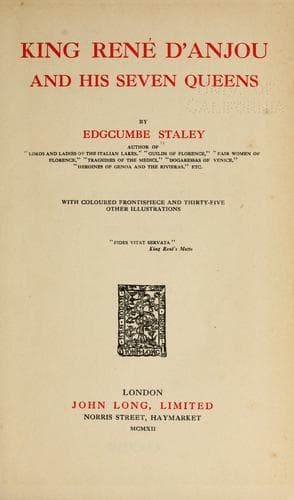
King René d'Anjou and His Seven QueensStaley, Edgcumbe
History
King René d'Anjou and His Seven Queens
Staley, Edgcumbe
France -- Court and courtiers; René I, King of Naples and Jerusalem, 1409-1480
habitation,--is still called _La Maison de la Reine Cicile_ (Sicily).
In this humble abode Yolanda d’Arragona, “the great Queen,” died
quietly on December 14, 1443.
Whether King René was present to close his beloved mother’s eyes we
know not, but it is significant of absence that the expense,--500
livres,--of the Queen’s obsequies was borne by her youngest son,
Charles, Duke of Maine; indeed, it is almost certain that René was at
Marseilles when he heard of his mother’s death. In one of his “_Livres
des Heures_” he inscribed: “_Le 14 Decembre de l’an 1443 trespassa au
Château de Saumur Madame Yolande, fille de Roy d’Aragon et depuis mère
de Roy René_.” The funeral ceremonies were celebrated by the Archbishop
of Tours, her private chaplain, not at Saumur, but at Angers, in
the Cathedral of St. Maurice, to which her remains were conveyed by
night two days after her death. Her grave was that of her consort’s,
twenty-five years before,--in front of the high-altar,--but all trace
of it has disappeared, and explorations have failed to reveal her
burial casket.
It is eloquent of the irony of human affairs, that whereas no
memorial, or even inscription, is left to record the virtues of the
royal mother of Anjou, in the Church of Nôtre Dame de Nantilly at
Saumur there is a memorial to Mère Théophaine la Magine, the devoted
nurse of King René and Queen Marie, who died March 13, 1458. The
original monument, erected by the King, presented his faithful domestic
holding him and Marie in her arms. This has been destroyed, but an
epitaph still remains:
“Cy gist la nourrice Théophaine
La Magine, qui ot grant paine
A nourrie de let en enfance
Marie d’Anjou, Royne de France,
Et après, son frère René, Duc d’Anjou.”
“Here lies good nurse Théophaine
La Magine, who at great pain
Foster-mother’d in infancy
Marie d’Anjou, Queen of France,
And then René, Duke of Anjou.”
The only existent memorials to King Louis II. and Queen Yolande are to
be seen in a stained-glass window in the Cathedral of St. Julien at
Le Mans, the capital of Maine, one of the richest and most beautiful
specimens of fifteenth-century glass in Europe. The royal couple are
upon their knees, attired in conventional costumes, and bare-headed.
Their youngest son, Charles of Anjou and Maine, is buried near that
splendid window, an interesting and curious circumstance in the
happenings of Providence. He died in 1474. All Anjou and Provence
bewailed their Queen, her virtues, her benevolence, her piety, her
loyalty.
Yolande’s claim to the title with which she has been honoured, “a good
mother and a great Queen,” needs no vindication. She was, in short, the
most noble woman in all France during the first half of the fifteenth
century.
CHAPTER IV
ISABELLE DE LORRAINE--“THE PRIDE OF LORRAINE”
I.
Public-domain text, read in full here on John Shaqi.
Reviews
Reviews
No reviews yet
Be the first to share your thoughts on this work.
Elsewhere in the archive
Join the Discussion
Join the discussion
Sign in to leave a comment or review.
Sign InorCreate an account