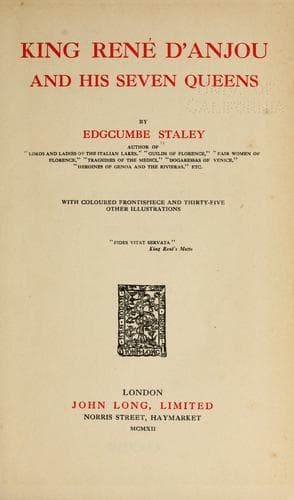
King René d'Anjou and His Seven QueensStaley, Edgcumbe
History
King René d'Anjou and His Seven Queens
Staley, Edgcumbe
France -- Court and courtiers; René I, King of Naples and Jerusalem, 1409-1480
At the time of their marriage, Charles II. of Lorraine and Margaret
of Bavaria were a model couple upon the principles of dissimilarity
and contrast. The Duke, a soldier born, had made good his degree of
knighthood ten years before, when, a mere stripling, he won his spurs
fighting daringly by the side of his cousin, Philippe “le Hardi,”
Duke of Burgundy. With him he went on a punitive expedition against
the pirates of the Barbary coast. At Rosebach, and especially at the
tremendous battle of Azincourt, he did prodigies of valour. In Flanders
and in Germany his ensign led on victorious troops. Charles’s last
military achievement was the rout of the Emperor Wenceslas under the
very walls of Nancy. No warrior loved fighting more than the Duke of
Lorraine. Slightly to alter the text, he was one of those war-lords
whom Shakespeare, in his “seven ages of man,” says “sought reputation
at the cannon’s mouth.” He yearned for the applause of gallant knights,
both friends and foes; he yielded himself amorously to the smiles and
embraces of the fair sex, and he revelled in the praise and adulation
of poets and minstrels. His mailed fist was ever toying with his trusty
sword and grappling the chafing-reins of his charger; his mailed foot
was ever ready for the stirrup and to trample upon the head of a fallen
foe.
At the same time he was a gay and polished courtier, one of the most
accomplished Princes in Europe. Fond of literature and poetry, he
studied daily his Latin copy of the “Commentaries of Julius Cæsar” and
similar treatises. He had besides a taste for music, and was no mean
exponent of the lute and guitar, and a friend of troubadours.
On the other hand, the gentle, lovable Duchess was born for the
cloister and for the worship of the Mass. Her bare feet were ever
moving in penitential pilgrimages and religious processions, and her
shapely hands were ever joined in prayer or divided in charity. Her
passion was the submissive rule of Christ, her will the conquest of
herself.
Daring and devotion thus harnessed together rocked the family cradle,
and insured for their offspring the best of two worlds. Such a union
was bound to be productive of genius and corrective of faults of
heredity. What a bitter disappointment, then, it must have been for
both the Duke and the Duchess when one after another their beauteous
babes and adolescent sons dropped like blighted rosebuds from their
young love’s rosebush prematurely into the cold, dark grave, leaving
only the aroma of their sweet young lives to soothe their sorrowing
parents!
Public-domain text, read in full here on John Shaqi.
Reviews
Reviews
No reviews yet
Be the first to share your thoughts on this work.
Elsewhere in the archive
Join the Discussion
Join the discussion
Sign in to leave a comment or review.
Sign InorCreate an account