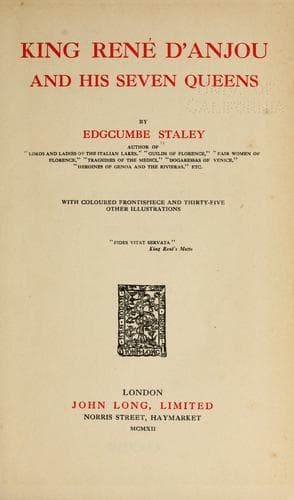
King René d'Anjou and His Seven QueensStaley, Edgcumbe
History
King René d'Anjou and His Seven Queens
Staley, Edgcumbe
France -- Court and courtiers; René I, King of Naples and Jerusalem, 1409-1480
Isabelle was the fairest daughter of the three. She inherited the force
of character of her father and the pious disposition of her mother, and
to these precious traits she joined a spirit of intelligence much in
advance of her years as a growing girl. In short, she was remarkable
“_pour ses qualités de l’esprit et du cœur_,” a description difficult
to render into good English; perhaps we may say she had her father’s
will and her mother’s love.
Many were the suitors for her hand, some for the pure love of beauty,
grace, and spirit, but most with a view to the Duke-consortship in the
future of rich Lorraine. The “Pride of Lorraine,” indeed, served as
an ever-reinforced magnet. She became remarkable for her loveliness
of person, her animation of manner, and her distinguished carriage.
The natural sweetness of her voice lent a gracious persuasiveness to
her eloquence, which in later life proved invaluable in the recruiting
of adherents to her husband’s cause. High-souled and condescending,
she brought her enemies to her feet, only to raise them her warmest
friends. Talented beyond the average of Princesses, she had also
the charm of winsome gaiety, and proved herself a worthy spouse
and companion for her gallant and clever consort René. Tall, slim,
fair-haired, blue-eyed, with a skin of satin softness, the “Pride of
Lorraine” won all hearts and turned many a head.
To Louis, Cardinal de Bar, was due the accomplishment of an idea
suggested by Queen Yolande with respect to the future of her second
son, René d’Anjou. He had for ever so long been considering what
steps he should take with respect to the succession to the duchy. He
of course, as an ecclesiastic, could have no legitimate offspring.
His brothers had died childless, and only one of his sisters had male
descendants, the grandsons of Violante de Bar, his own grand-nephews.
In His Eminence’s mind, too, was a project to reconstitute the
ancient kingdom of Lothair by merging Barrois and Lorraine proper.
Whilst Duke Charles II.’s young sons were living, the Cardinal looked
to one of them as his heir; and when they all drooped and died, he
reflected whether or not he should name Charles as his successor. At
this juncture his niece, the Queen of Sicily-Anjou, was busy looking
out for brides for her two elder sons, Louis and René. For the former
a Bretagne alliance was indicated; for the latter a union with
Lorraine--Burgundy for the time being out of the question--or Champagne
seemed desirable.
Public-domain text, read in full here on John Shaqi.
Reviews
Reviews
No reviews yet
Be the first to share your thoughts on this work.
Elsewhere in the archive
Join the Discussion
Join the discussion
Sign in to leave a comment or review.
Sign InorCreate an account