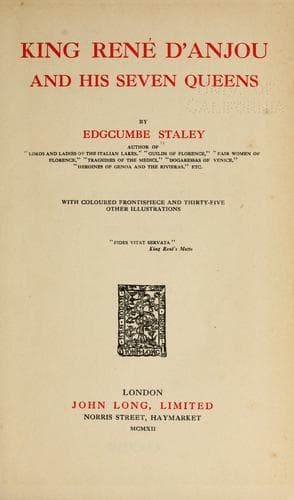
King René d'Anjou and His Seven QueensStaley, Edgcumbe
History
King René d'Anjou and His Seven Queens
Staley, Edgcumbe
France -- Court and courtiers; René I, King of Naples and Jerusalem, 1409-1480
René, only twelve years old, the following year accompanied Charles II.
of Lorraine to the siege of Toul,--for many years a turbulent element
in his dominions,--where there was a hot dispute concerning certain
laws and customs oppositive to the claims of the crown of Lorraine.
Toul was captured, and mulcted in an annual tribute of a thousand
livres.
Directly the proclamation of Isabelle of Lorraine with René as the
sharer of her throne was made, Antoine de Vaudémont, Duke Charles’s
eldest nephew, entered a protest and claimed the succession. He based
his action upon the three conditions--(1) The Salic Law ruled the
succession of Lorraine; (2) the male line had not been broken since
the creation of the duchy; and (3) the realm had never gone out of the
family. Charles scouted all these positions, affirmed his own sovereign
right to name his successor, and refused to alter the terms of the
proclamation so far as regarded the succession of his daughter and Duke
René.
All the church-bells in Barrois and Lorraine were again set
jingling joyously when, in the ducal castle of Toul, on the morning
of January 17, 1437, a young mother,--very young indeed, barely
seventeen,--brought forth her first-born--a beauteous boy, the
image, as the midwives said, of the boy-father, not yet nineteen.
Church-bells, too, rang merrily all over Anjou and Provence when the
glad tidings reached their borders that a male heir was born to the
honours of Sicily-Anjou-Provence. Perhaps René and Isabelle were too
young to realize what it all meant for France at large, but Queen
Yolande understood well enough its tenor, and with her congratulations
she greeted her first son’s grandchild with the title of “Prince of
Gerona,” linking him ostentatiously with her hereditary rights in
Aragon. Duke Charles, too, and Duchess Margaret were the happiest of
grandparents, and baby Jean was created Comte de Nancy as future Duke.
Charles’s death was somewhat sudden and quite unexpected. Strong man
that he was, King Death seemed to be a power not immediately to be
feared. René was not at Nancy when the death-knell sounded, but news
swiftly reached him, and he returned at once to the capital. Duchess
Margaret,--despite her lamentations and her natural dislike to public
appearance,--attired herself in full Court dress, the crown she rarely
wore upon her head, and all the officials of the Court, the Government,
and city, in her retinue, and hastened to the gate to welcome the
new Duke of Lorraine. Before her carriage rode a number of lords and
knights, who dismounted on the approach of René, and, saluting him
deferentially, greeted him as “_Vous estoit le nostre duc!_” The cry
was taken up by all the gallant company, whilst René, having dismounted
at the portal of St. George, took the sacred missal offered by the Dean
into his hands, and swore then and there to respect and safeguard the
ancient liberties of the State and city.
Public-domain text, read in full here on John Shaqi.
Reviews
Reviews
No reviews yet
Be the first to share your thoughts on this work.
Elsewhere in the archive
Join the Discussion
Join the discussion
Sign in to leave a comment or review.
Sign InorCreate an account