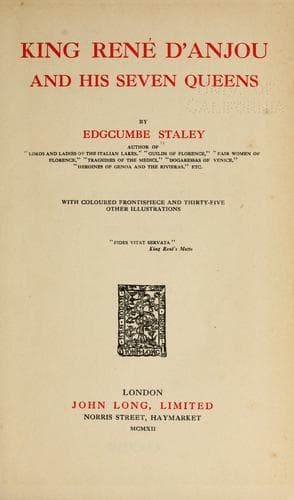
King René d'Anjou and His Seven QueensStaley, Edgcumbe
History
King René d'Anjou and His Seven Queens
Staley, Edgcumbe
France -- Court and courtiers; René I, King of Naples and Jerusalem, 1409-1480
On November 10 formal proclamation was made in every important town
in Lorraine, to the effect that Duke Charles II. constituted his
eldest daughter, now Duchess of Barrois and Countess of Guise, heiress
to the duchy of Lorraine, and confirmed to her, and to her issue by
René d’Anjou and Bar, full rights of succession and government. The
proclamation named Queen Yolande of Sicily-Anjou, Louis, Cardinal de
Bar, and the Duke himself, Charles’s guardians during the minority of
the young couple.
“René,” wrote a chronicler, “is well-grown, well-bred, and
well-looking. He is greatly admired by all the fair sex, and loves them
in return. He will make a good husband, and has the making of a great
Sovereign.” The bride’s praises were sung by poets and minstrels the
length and breadth of Lorraine and Bar.
Among the earliest to congratulate the young people and their parents
was the redoubtable Duke of Burgundy! He sent a special embassy to
Nancy with this striking message: “_Tous estoient si joyeulx de veoir
la fervente et cordiale amour qui estoit entre ces deulx jeuns gens,
que je me trouve capable des sentiments les plus amiables pour tous
mes cousins royales. Je salue mes bons frères les Souverains Ducs
de Lorraine et Barrois avec Madame la Duchesse Marguerite, et sans
autre choses la bonne Rogne de Cecile, son épous le Roy Louis, pour
jamais._”[A]
[A] “Everybody was delighted to behold the fervent and cordial
love which exists between the two young people, whilst I found
myself filled with the most amiable sentiments for all my
royal cousins. I salute my good brothers the Sovereign Dukes
of Lorraine and Barrois, and also the Duchess Margaret, and
equally the good Queen of Sicily and her consort King Louis.”
This was as a jewel in the hair of Queen Yolande, and as nectar in the
cup of Cardinal Louis. Their plans had succeeded splendidly.
Shortly after his marriage, René returned to Bar-le-Duc with his
child-bride, and they were received in royal state by the Cardinal,
who had renovated and decorated the castle specially in their honour
and for their use. The town of Ligny was causing trouble in Barrois by
refusing to pay the accustomed tribute. The Prince de Ligny claimed
that portion of the duchy of Bar as his, by the marriage contract of
his wife, the Cardinal’s sister. He attacked the Castle of Pierrepoint
and the town of Briey, whose garrison he caused to be put to the
sword. The Cardinal took arms, and, accompanied by René and companies
of Lorraine soldiers from Longwy, defeated his relative and took him
prisoner. The young Prince received the rebel’s sword and personally
conducted him to Nancy, where, after two years’ confinement in the
fortress, he signed an act of renunciation of his pretensions in
Barrois.
Public-domain text, read in full here on John Shaqi.
Reviews
Reviews
No reviews yet
Be the first to share your thoughts on this work.
Elsewhere in the archive
Join the Discussion
Join the discussion
Sign in to leave a comment or review.
Sign InorCreate an account