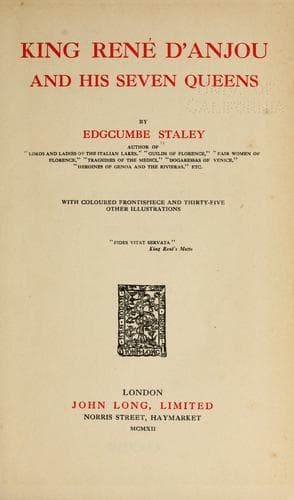
King René d'Anjou and His Seven QueensStaley, Edgcumbe
History
King René d'Anjou and His Seven Queens
Staley, Edgcumbe
France -- Court and courtiers; René I, King of Naples and Jerusalem, 1409-1480
With scant reverence for the sacred edifice, and with much discourtesy
to the Emperor and the dignitaries who sat with him as assessors,--the
Papal Legate and the Patriarch of Constantinople,--Vaudémont
indignantly refused to accept the imperial ruling, and demanded the
immediate payment of the 20,000 _saluts d’or_ or the prompt return of
Duke René to Bracon. Duchess Isabelle, who had courageously accompanied
her husband, fell upon her knees before their stern, irreconcilable
enemy, and pleaded with him to extend knightly magnanimity towards
his prisoner. No! Vaudémont would have the duchy or René’s money or
his person. René, gently raising his loving spouse, led her from the
scene, and then, tenderly embracing her, he returned to where he had
left Vaudémont scowling. “See,” said he, “here I am: take me at once
to Dijon.” Before leaving the Imperial Court the Emperor beckoned
to him, and, directing him to kneel, formally invested him with the
temporalities of the duchy of Lorraine, and upon Isabelle he bestowed
with the Papal benediction the honour of the “Golden Rose.”
Torn from the bosom of his family once more, René bore his misfortune
like a man, and Isabelle rose superior to her trouble. Their noble
bearing gained further the respect and good-will of all the Sovereigns
and peoples of Europe, whilst the spleen and meanness of Vaudémont
rendered him odious everywhere. René submitted obediently to the
newly-imposed discipline. He beguiled his time by adorning the walls
and windows of his chamber with sketches and paintings. What a thousand
pities it is that none of those treasures have been preserved! Alas!
France has suffered more than any other land from the suicidal
tendencies of her people. Over and over again national passion has
swept away works of art and historical memorials. King René’s frescoes
have, with the fortress of Bracon, wholly disappeared. Music, too,
and poetry, formed for him consolations. He composed _ballades_, he
sang songs, sacred and profane. He played the viol and zither, and so
whiled away some of the tedium of his captivity. “_Les Chroniques de
Lorraine_,” note that “_il a sçu la musique, et marier la voix aulx
doulx accents d’un luth, gémissant sous ses doigts_.”[A]
[A] “He knew music, and how to modulate his voice to the notes
of a lute, striking it with his fingers.”
At Bracon was the Duke of Burgundy’s splendid library, to which René
was freely admitted. There he studied painstakingly classical works in
Greek, Latin, and Hebrew.
Cut off as he was entirely from intercourse with his family, friends,
and subjects, at times he gave way to melancholy, and regarded himself
as unjustly treated by Providence. He craved to behold his children,
and this longing was assuaged by the chivalrous consideration of the
Duke of Burgundy, who permitted the little Princes Jean and Louis to
visit their unhappy father in his prison.
II.
Public-domain text, read in full here on John Shaqi.
Reviews
Reviews
No reviews yet
Be the first to share your thoughts on this work.
Elsewhere in the archive
Join the Discussion
Join the discussion
Sign in to leave a comment or review.
Sign InorCreate an account