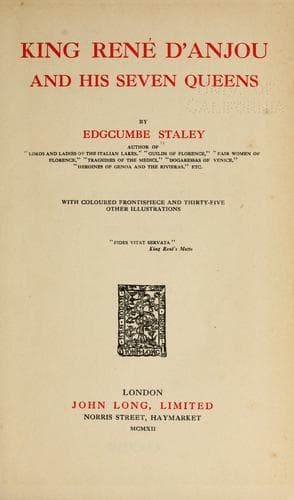
King René d'Anjou and His Seven QueensStaley, Edgcumbe
History
King René d'Anjou and His Seven Queens
Staley, Edgcumbe
France -- Court and courtiers; René I, King of Naples and Jerusalem, 1409-1480
The years 1434 and 1435 were full of tragic happenings for René and
Isabelle. Death claimed three important personages near of kin.
All Lorraine mourned the saintly Duchess Margaret. She died in her
devoted daughter’s arms during the feast of Pentecost, and they
buried her beside her consort, Charles II., in the ducal tomb at
St. George-by-the-Gate. Her quiet influence had been all for good,
both upon her children’s account and upon the morals of the Court
and nation. She could, as we have seen, act the heroine as well as
the devotee. Isabelle missed her mother’s goodly counsels more than
she could express in words. René’s greatest loss was undoubtedly his
brother, Louis III., King of Sicily-Anjou and Naples. This bereavement
wholly changed the position and prospects of the Bar-Lorraine ducal
family; for Louis dying without surviving issue, all his honours,
titles, and dominions, were inherited by his next brother, René.
This event, and what it meant for René, were the climax of his
career. The proclamation of the new King was a tragedy and a travesty
combined. The pathos of his position was emphatic. The news stunned
him--powerless and wellnigh nerveless, hopeless and wellnigh demented.
He had not regained his equanimity, when the mockery of his fate was
borne still more cruelly upon him in the intelligence that reached
him on February 2, 1435, in the Tour de Bar, of the demise of Queen
Giovanna II., whose will named him her successor as King of Naples.
Louis died of fever at Cosenza, the capital of Calabria, on November
15, 1434, lamented by his enemies as well as by his friends. His
devoted mother was not with him. She was broken-hearted at the news
which reached her at Angers. Alas that so gallant a soldier-King
should be cut off so suddenly and so prematurely in the first bloom
of his manhood! Cast down with grief unspeakable and mute, his
girl-wife--still a bride--Marguerite, consoled his last hours. No child
had come to bless their union, and the palpitating passion of the
honeymoon was naturally cooling. The stress, too, of martial movements
separated all too soon and too frequently the bridal couple. Still,
Queen Marguerite ministered tenderly to her sick spouse, and her
love burst forth in undiminished fervency as she realized that death
would so cruelly part them. Very nobly and unselfishly, Louis in his
will,--very strangely, made exactly to the day a year before,--required
all honour to be paid to his widow, for his sake as well as for her
own, and left her the bulk of his private property--alas! greatly
diminished by the expenses of his military campaigns. Moreover, he
expressly directed that she should be free to go where she would,--if
not to Anjou, then to her home again in Savoy,--and he besought her,
“for the love she bore him, not to pine away in sadness, but to choose
some good man and marry him, for the relief of nature and for the love
of God.”
Public-domain text, read in full here on John Shaqi.
Reviews
Reviews
No reviews yet
Be the first to share your thoughts on this work.
Elsewhere in the archive
Join the Discussion
Join the discussion
Sign in to leave a comment or review.
Sign InorCreate an account