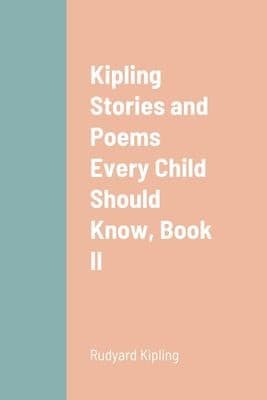
Kipling Stories and Poems Every Child Should Know, Book IIKipling, Rudyard
General
Kipling Stories and Poems Every Child Should Know, Book II
Kipling, Rudyard
Poetry; Short stories
His literary gifts came to him by inheritance from both the father and
mother, and they were nurtured and cultivated in the circle of
relatives and family friends with whom his holidays were spent. A
sub-master at Westward Ho, though little satisfied with the boy's
progress in the studies of the school, gave to him the liberty of his
own excellent library. The holidays were spent at the Grange, in South
Kensington, the home of his aunt and uncle, Mr. and Mrs. Burne-Jones,
and here he came under the happiest possible domestic influences, and
was brought into contact with men of highest quality, whose lives were
given to letters and the arts, especially with William Morris, the
closest intimate of the household of the Grange. Other homes were open
to him where the pervading influence was that of intellectual
pursuits, and where he had access to libraries through which he was
allowed to wander and to browse at his will. The good which came to
him, directly and indirectly, from these opportunities can hardly be
overstated. To know, to love, and to be loved by such a man as
Burne-Jones was a supreme blessing in his life.
In the autumn of 1882, having finished his course at school, a
position was secured for him on the _Civil and Military Gazette_,
Lahore, and he returned to his parents in India, who had meanwhile
removed from Bombay to Lahore, where his father was at the head of the
most important school of the arts in India. The _Civil and Military
Gazette_ is the chief journal of northwestern India, owned and
conducted by the managers and owners of the Allahabad _Pioneer_, the
ablest and most influential of all Indian newspapers published in the
interior of the country.
For five years he worked hard and steadily on the _Gazette_. Much of
the work was simple drudgery. He shirked nothing. The editor-in-chief
was a somewhat grim man, who believed in snubbing his subordinates,
and who, though he recognized the talents of the "clever pup," as he
called him, and allowed him a pretty free hand in his contributions to
the paper, yet was inclined to exact from him the full tale of the
heavy routine work of a newspaper office.
Public-domain text, read in full here on John Shaqi.
Reviews
Reviews
No reviews yet
Be the first to share your thoughts on this work.
Join the Discussion
Join the discussion
Sign in to leave a comment or review.
Sign InorCreate an account