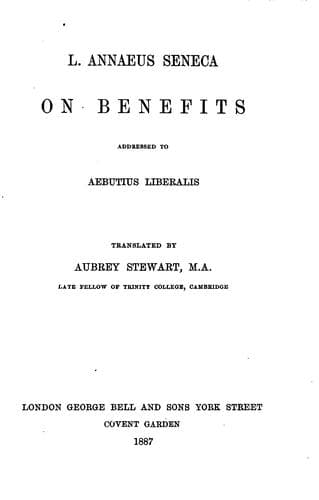
L. Annaeus Seneca on BenefitsSeneca, Lucius Annaeus
Philosophy
L. Annaeus Seneca on Benefits
Seneca, Lucius Annaeus
Benevolence; Classical literature; Conduct of life; Essays
III. The Lacedaemonians forbid their young men to contend in the
pancratium, or with the caestus, in which games the defeated party has
to acknowledge himself beaten. The winner of a race is he who first
reaches the goal; he outstrips the others in swiftness, but not in
courage. The wrestler who has been thrown three times loses the palm of
victory, but does not yield it up. Since the Lacedaemonians thought it
of great importance that their countrymen should be invincible, they
kept them away from those contests in which victory is assigned, not by
the judge, or by the issue of the contest itself, but by the voice
of the vanquished begging the victor to spare him as he falls. This
attribute of never being conquered, which they so jealously guard among
their citizens, can be attained by all men through virtue and goodwill,
because even when all else is vanquished, the mind remains unconquered.
For this cause no one speaks of the three hundred Fabii as conquered,
but slaughtered. Regulus was taken captive by the Carthaginians, not
conquered; and so were all other men who have not yielded in spirit when
overwhelmed by the strength and weight of angry fortune.
So is it with benefits. A man may have received more than he gave, more
valuable ones, more frequently bestowed; yet is he not vanquished. It
may be that, if you compare the benefits with one another, those which
he has received will outweigh those which he has bestowed; but if you
compare the giver and the receiver, whose intentions also ought to be
considered apart, neither will prove the victor. It often happens that
even when one combatant is pierced with many wounds, while the other is
only slightly injured, yet they are said to have fought a drawn battle,
although the former may appear to be the worse man.
Public-domain text, read in full here on John Shaqi.
Reviews
Reviews
No reviews yet
Be the first to share your thoughts on this work.
Elsewhere in the archive
Join the Discussion
Join the discussion
Sign in to leave a comment or review.
Sign InorCreate an account