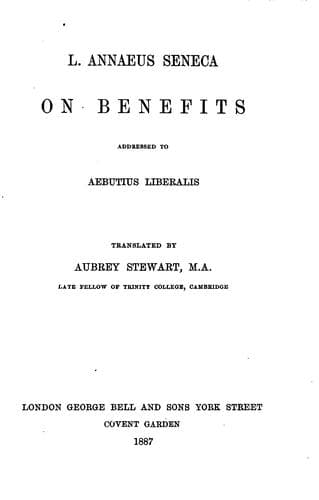
L. Annaeus Seneca on BenefitsSeneca, Lucius Annaeus
Philosophy
L. Annaeus Seneca on Benefits
Seneca, Lucius Annaeus
Benevolence; Classical literature; Conduct of life; Essays
IV. No one, therefore, can be conquered in a contest of benefits, if he
knows how to owe a debt, if he wishes to make a return for what he
has received, and raises himself to the same level with his friend in
spirit, though he cannot do so in material gifts. As long as he remains
in this temper of mind, as long as he has the wish to declare by proofs
that he has a grateful mind, what difference does it make upon which
side we can count the greater number of presents? You are able to give
much; I can do nothing but receive. Fortune abides with you, goodwill
alone with me; yet I am as much on an equality with you as naked or
lightly armed men are with a large body armed to the teeth. No one,
therefore, is worsted by benefits, because each man's gratitude is to be
measured by his will. If it be disgraceful to be worsted in a contest
of benefits, you ought not to receive a benefit from very powerful men
whose kindness you cannot return, I mean such as princes and kings, whom
fortune has placed in such a station that they can give away much, and
can only receive very little and quite inadequate returns for what they
give. I have spoken of kings and princes, who alone can cause works to
be accomplished, and whose superlative power depends upon the obedience
and services of inferiors; but some there are, free from all earthly
lusts, who are scarcely affected by any human objects of desire, upon
whom fortune herself could bestow nothing. I must be worsted in a
contest of benefits with Socrates, or with Diogenes, who walked naked
through the treasures of Macedonia, treading the king's wealth under his
feet. In good sooth, he must then rightly have seemed, both to himself
and to all others whose eyes were keen enough to perceive the real
truth, to be superior even to him at whose feet all the world lay.
He was far more powerful, far richer even than Alexander, who then
possessed everything; for there was more that Diogenes could refuse to
receive than that Alexander was able to give.
Public-domain text, read in full here on John Shaqi.
Reviews
Reviews
No reviews yet
Be the first to share your thoughts on this work.
Elsewhere in the archive
Join the Discussion
Join the discussion
Sign in to leave a comment or review.
Sign InorCreate an account