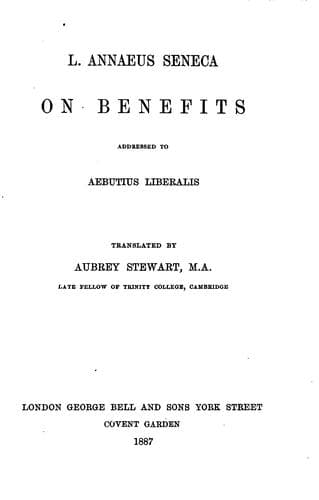
L. Annaeus Seneca on BenefitsSeneca, Lucius Annaeus
Philosophy
L. Annaeus Seneca on Benefits
Seneca, Lucius Annaeus
Benevolence; Classical literature; Conduct of life; Essays
VI. Alexander, the king of the Macedonians, used to boast that he had
never been worsted by anybody in a contest of benefits. If so, it was
no reason why, in the fulness of his pride, he should despise the
Macedonians, Greeks, Carians, Persians, and other tribes of whom his
army was composed, nor need he imagine that it was this that gave him an
empire reaching from a corner of Thrace to the shore of the unknown
sea. Socrates could make the same boast, and so could Diogenes, by whom
Alexander was certainly surpassed; for was he not surpassed on the day
when, swelling as he was beyond the limits of merely human pride,
he beheld one to whom he could give nothing, from whom he could take
nothing? King Archelaus invited Socrates to come to him. Socrates is
reported to have answered that he should be sorry to go to one who would
bestow benefits upon him, since he should not be able to make him an
adequate return for them. In the first place, Socrates was at liberty
not to receive them; next, Socrates himself would have been the first
to bestow a benefit, for he would have come when invited, and would have
given to Archelaus that for which Archelaus could have made no return to
Socrates. Even if Archelaus were to give Socrates gold and silver, if
he learned in return for them to despise gold and silver, would not
Socrates be able to repay Archelaus? Could Socrates receive from him
as much value as he gave, in displaying to him a man skilled in the
knowledge of life and of death, comprehending the true purpose of each?
Suppose that he had found this king, as it were, groping his way in the
clear sunlight, and had taught him the secrets of nature, of which he
was so ignorant, that when there was an eclipse of the sun, he up his
palace, and shaved his son's head, [Footnote: Gertz very reasonably
conjectures that he shaved his own head which reading would require a
very trifling alteration of the text.] which men are wont to do in times
of mourning and distress. What a benefit it would have been if he had
dragged the terror-stricken king out of his hiding-place, and bidden him
be of good cheer, saying, "This is not a disappearance of the sun, but a
conjunction of two heavenly bodies; for the moon, which proceeds along
a lower path, has placed her disk beneath the sun, and hidden it by the
interposition of her own mass. Sometimes she only hides a small portion
of the sun's disk, because she only grazes it in passing; sometimes
she hides more, by placing more of herself before it; and sometimes she
shuts it out from our sight altogether, if she passes in an exactly even
course between the sun and the earth. Soon, however, their own swift
motion will draw these two bodies apart; soon the earth will receive
back again the light of day. And this system will continue throughout
centuries, having certain days, known beforehand, upon which the sun
cannot display all rays, because of the intervention of the moon. Wait
Public-domain text, read in full here on John Shaqi.
Reviews
Reviews
No reviews yet
Be the first to share your thoughts on this work.
Elsewhere in the archive
Join the Discussion
Join the discussion
Sign in to leave a comment or review.
Sign InorCreate an account