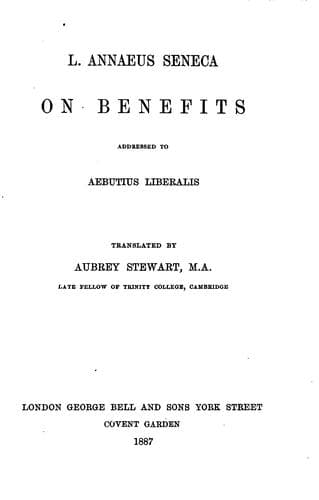
L. Annaeus Seneca on BenefitsSeneca, Lucius Annaeus
Philosophy
L. Annaeus Seneca on Benefits
Seneca, Lucius Annaeus
Benevolence; Classical literature; Conduct of life; Essays
only for a short time; he will soon emerge, he will soon leave that
seeming cloud, and freely shed abroad his light without any hindrances."
Could Socrates not have made an adequate return to Archelaus, if he
had taught him to reign? as though Socrates would not benefit him
sufficiently, merely by enabling him to bestow a benefit upon Socrates.
Why, then, did Socrates say this? Being a joker and a speaker in
parables--a man who turned all, especially the great, into ridicule--he
preferred giving him a satirical refusal, rather than an obstinate or
haughty one, and therefore said that he did not wish to receive benefits
from one to whom he could not return as much as he received. He feared,
perhaps, that he might be forced to receive something which he did
not wish, he feared that it might be something unfit for Socrates to
receive. Some one may say, "He ought to have said that he did not wish
to go." But by so doing he would have excited against himself the anger
of an arrogant king, who wished everything connected with himself to be
highly valued. It makes no difference to a king whether you be unwilling
to give anything to him or to accept anything from him; he is equally
incensed at either rebuff, and to be treated with disdain is more
bitter to a proud spirit than not to be feared. Do you wish to know what
Socrates really meant? He, whose freedom of speech could not be borne
even by a free state, was not willing of his own choice to become a
slave.
VII. I think that we have sufficiently discussed this part of the
subject, whether it be disgraceful to be worsted in a contest of
benefits. Whoever asks this question must know that men are not wont
to bestow benefits upon themselves, for evidently it could not be
disgraceful to be worsted by oneself. Yet some of the Stoics debate this
question, whether any one can confer a benefit upon himself, and whether
one ought to return one's own kindness to oneself. This discussion has
been raised in consequence of our habit of saying, "I am thankful
to myself," "I can complain of no one but myself," "I am angry with
myself," "I will punish myself," "I hate myself," and many other phrases
of the same sort, in which one speaks of oneself as one would of some
other person. "If," they argue, "I can injure myself, why should I not
be able also to bestow a benefit upon myself? Besides this, why are
those things not called benefits when I bestow them upon myself which
would be called benefits if I bestowed them upon another? If to receive
a certain thing from another would lay me under an obligation to him,
how is it that if I give it to myself, I do not contract an obligation
to myself? why should I be ungrateful to my own self, which is no less
disgraceful than it is to be mean to oneself, or hard and cruel to
oneself, or neglectful of oneself?" The procurer is equally odious
whether he prostitutes others or himself. We blame a flatterer, and one
Public-domain text, read in full here on John Shaqi.
Reviews
Reviews
No reviews yet
Be the first to share your thoughts on this work.
Elsewhere in the archive
Join the Discussion
Join the discussion
Sign in to leave a comment or review.
Sign InorCreate an account