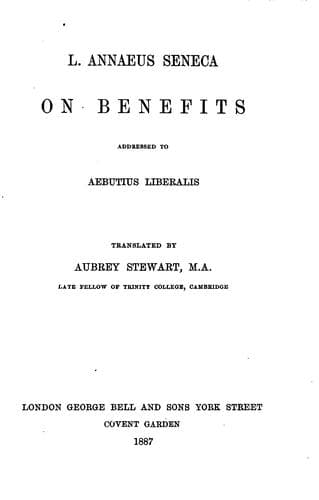
L. Annaeus Seneca on BenefitsSeneca, Lucius Annaeus
Philosophy
L. Annaeus Seneca on Benefits
Seneca, Lucius Annaeus
Benevolence; Classical literature; Conduct of life; Essays
do I bestow or repay a benefit? In the next place, even if I grant the
primary axiom, that we can bestow benefits upon ourselves, I do not
admit that which follows; for even if we can do so, we ought not to do
so. Wherefore? Because we receive a return for them at once. It is right
for me to receive a benefit, then to lie under an obligation, then to
repay it; now here there is no time for remaining under an obligation,
because we receive the return without any delay. No one really gives
except to another, no one owes except to another, no one repays except
to another. An act which always requires two persons cannot take place
within the mind of one.
X. A benefit means the affording of something useful, and the word
AFFORDING implies other persons. Would not a man be thought mad if
he said that he had sold something to himself, because selling means
alienation, and the transferring of a thing and of one's rights in that
thing to another person? Yet giving, like selling anything, consists in
making it pass away from you, handing over what you yourself once owned
into the keeping of some one else.
If this be so, no one ever gave himself a benefit, because no one gives
to himself; if not, two opposites coalesce, so that it becomes the same
thing to give and to receive. Yet there is a great difference between
giving and receiving; how should there not be, seeing that these words
are the converse of one another? Still, if any one can give himself a
benefit, there can be no difference between giving and receiving. I said
a little before that some words apply only to other persons, and are
so constituted that their whole meaning lies apart from ourselves; for
instance, I am a brother, but a brother of some other man, for no one is
his own brother; I am an equal, but equal to somebody else, for who
is equal to himself? A thing which is compared to another thing is
unintelligible without that other thing; a thing which is joined to
something else does not exist apart from it; so that which is given does
not exist without the other person, nor can a benefit have any existence
without another person. This is clear from the very phrase which
describes it, 'to do good,' yet no one does good to himself, any more
than he favours himself or is on his own side. I might enlarge further
upon this subject and give many examples. Why should benefits not be
included among those acts which require two persons to perform them?
Many honourable, most admirable and highly virtuous acts cannot take
place without a second person. Fidelity is praised and held to be one
of the chief blessings known among men, yet was any one ever on that
account said to have kept faith with himself?
Public-domain text, read in full here on John Shaqi.
Reviews
Reviews
No reviews yet
Be the first to share your thoughts on this work.
Elsewhere in the archive
Join the Discussion
Join the discussion
Sign in to leave a comment or review.
Sign InorCreate an account