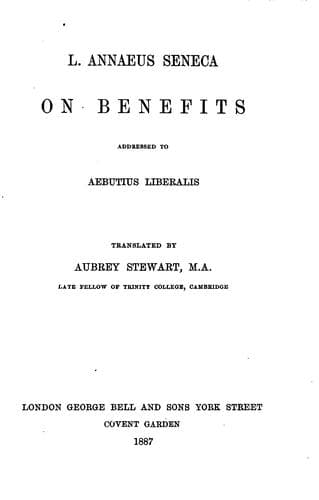
L. Annaeus Seneca on BenefitsSeneca, Lucius Annaeus
Philosophy
L. Annaeus Seneca on Benefits
Seneca, Lucius Annaeus
Benevolence; Classical literature; Conduct of life; Essays
before, and what went down on one side coming up on the other, so that
all the parts, in whatever direction they may move, come back to the
same position. Imagine that the same thing takes place in a man; into
however many pieces you may divide him, he remains one. If he strikes
himself, he has no one to call to account for the insult; if he binds
himself and locks himself up, he cannot demand damages; if he bestows a
benefit upon himself, he straightway returns it to the giver. It is said
that there is no waste in nature, because everything which is taken from
nature returns to her again, and nothing can perish, because it cannot
fall out of nature, but goes round again to the point from whence
it started. You ask, "What connection has this illustration with the
subject?" I will tell you. Imagine yourself to be ungrateful, the
benefit bestowed upon you is not lost, he who gave it has it; suppose
that you are unwilling to receive it, it still belongs to you before it
is returned. You cannot lose anything, because what you take away from
yourself, you nevertheless gain yourself. The matter revolves in a
circle within yourself; by receiving you give, by giving you receive.
IX. "It is our duty," argues our adversary, "to bestow benefits upon
ourselves, therefore we ought also to be grateful to ourselves." The
original axiom, upon which the inference depends, is untrue, for no one
bestows benefits upon himself, but obeys the dictates of his nature,
which disposes him to affection for himself, and which makes him take
the greatest pains to avoid hurtful things, and to follow after those
things which are profitable to him. Consequently, the man who gives to
himself is not generous, nor is he who pardons himself forgiving, nor is
he who is touched by his own misfortunes tender-hearted; it is
natural to do those things to oneself which when done to others become
generosity, clemency, and tenderness of heart. A benefit is a voluntary
act, but to do good to oneself is an instinctive one. The more benefits
a man bestows, the more beneficent he is, yet who ever was praised for
having been of service to himself? or for having rescued himself from
brigands? No one bestows a benefit upon himself any more than he bestows
hospitality upon himself; no one gives himself anything, any more than
he lends himself anything. If each man bestows benefits upon himself, is
always bestowing them, and bestows them without any cessation, then
it is impossible for him to make any calculation of the number of his
benefits; when then can he show his gratitude, seeing that by the very
act of doing so he would bestow a benefit? for what distinction can
you draw between giving himself a benefit or receiving a benefit for
himself, when the whole transaction takes place in the mind of the same
man? Suppose that I have freed myself from danger, then I have bestowed
a benefit upon myself; suppose I free myself a second time, by so doing
Public-domain text, read in full here on John Shaqi.
Reviews
Reviews
No reviews yet
Be the first to share your thoughts on this work.
Elsewhere in the archive
Join the Discussion
Join the discussion
Sign in to leave a comment or review.
Sign InorCreate an account