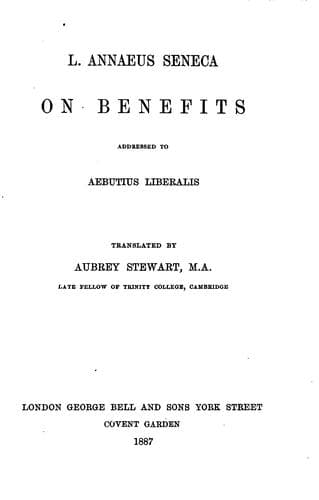
L. Annaeus Seneca on BenefitsSeneca, Lucius Annaeus
Philosophy
L. Annaeus Seneca on Benefits
Seneca, Lucius Annaeus
Benevolence; Classical literature; Conduct of life; Essays
trouble; and the more property they have to perplex them, the less
likely they are to find out what they really are. Nothing, therefore,
can reach bad men which would do them good; nay, nothing which would
not do them harm. They change whatever falls to their lot into their own
evil nature; and things which elsewhere would, if given to better men,
be both beautiful and profitable, are ruinous to them. They cannot,
therefore, bestow benefits, because no one can give what he does not
possess, and, therefore, they lack the pleasure of doing good to others.
XIII. But, though this be so, yet even a bad man can receive some things
which resemble benefits, and he will be ungrateful if he does not return
them. There are good things belonging to the mind, to the body, and to
fortune. A fool or a bad man is debarred from the first--those, that is,
of the mind; but he is admitted to a share in the two latter, and, if
he does not return them, he is ungrateful. Nor does this follow from
our (Stoic) system alone the Peripatetics, also, who widely extend the
boundaries of human happiness, declare that trifling benefits reach bad
men, and that he who does not return them is ungrateful. We therefore
do not agree that things which do not tend to improve the mind should
be called benefits, yet do not deny that these things are convenient and
desirable. Such things as these a bad man may bestow upon a good man,
or may receive from him--such, for example, as money, clothes, public
office, or life; and, if he makes no return for these, he will come
under the denomination of ungrateful. "But how can you call a man
ungrateful for not returning that which you say is not a benefit?" Some
things, on account of their similarity, are included under the same
designation, although they do not really deserve it. Thus we speak of
a silver or golden box; ["The original word is 'pyx,' which means a box
made of box-wood."] thus we call a man illiterate, although he may not
be utterly ignorant, but only not acquainted with the higher branches of
literature; thus, seeing a badly-dressed ragged man we say that we have
seen a naked man. These things of which we spoke are not benefits,
but they possess the appearance of benefits. "Then, just as they are
quasi-benefits, so your man is quasi-ungrateful, not really ungrateful."
This is untrue, because both he who gives and he who receives them
speaks of them as benefits; so he who fails to return the semblance of
a real benefit is as much an ungrateful man as he who mixes a sleeping
draught, believing it to be poison, is a poisoner.
Public-domain text, read in full here on John Shaqi.
Reviews
Reviews
No reviews yet
Be the first to share your thoughts on this work.
Elsewhere in the archive
Join the Discussion
Join the discussion
Sign in to leave a comment or review.
Sign InorCreate an account