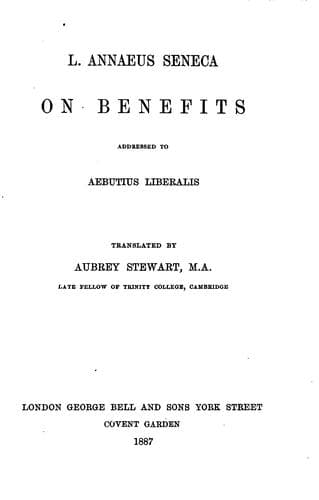
L. Annaeus Seneca on BenefitsSeneca, Lucius Annaeus
Philosophy
L. Annaeus Seneca on Benefits
Seneca, Lucius Annaeus
Benevolence; Classical literature; Conduct of life; Essays
XIV. Cleanthes speaks more impetuously than this. "Granted," says he,
"that what he received was not a benefit, yet he is ungrateful, because
he would not have returned a benefit if he had received one." So he who
carries deadly weapons and has intentions of robbing and murdering, is
a brigand even before he has dipped his hands in blood; his wickedness
consists and is shown in action, but does not begin thereby. Men are
punished for sacrilege, although no one's hands can reach to the gods.
"How," asks our opponent, "can any one be ungrateful to a bad man, since
a bad man cannot bestow a benefit?" In the same way, I answer, because
that which he received was not a benefit, but was called one; if any
one receives from a bad man any of those things which are valued by the
ignorant, and of which bad men often possess great store, it becomes his
duty to make a return in the same kind, and to give back as though they
were truly good those things which he received as though they were
truly good. A man is said to be in debt, whether he owes gold pieces
or leather marked with a state stamp, such as the Lacedaemonians used,
which passes for coined money. Pay your debts in that kind in which you
incurred them. You have nothing to do with the definition of benefits,
or with the question whether so great and noble a name ought to be
degraded by applying it to such vulgar and mean matters as these, nor do
we seek for truth that we may use it to the disadvantage of others;
do you adjust your minds to the semblance of truth, and while you are
learning what is really honourable, respect everything to which the name
of honour is applied.
XV. "In the same way," argues our adversary, "that your school proves
that no one is ungrateful, you afterwards prove that all men are
ungrateful. For, as you say, all fools are bad men; he who has one vice
has all vices; all men are both fools and bad men; therefore all men are
ungrateful." Well, what then? Are they not? Is not this the universal
reproach of the human race? is there not a general complaint that
benefits are thrown away, and that there are very few men who do not
requite their benefactors with the basest ingratitude? Nor need you
suppose that what we say is merely the grumbling of men who think
every act wicked and depraved which falls short of an ideal standard of
righteousness. Listen! I know not who it is who speaks, yet the voice
with which he condemns mankind proceeds, not from the schools of
philosophers, but from the midst of the crowd:
"Host is not safe from guest;
Father-in-law from son; but seldom love
Exists 'twixt brothers; wives long to destroy
Their husbands; husbands long to slay their wives."
Public-domain text, read in full here on John Shaqi.
Reviews
Reviews
No reviews yet
Be the first to share your thoughts on this work.
Elsewhere in the archive
Join the Discussion
Join the discussion
Sign in to leave a comment or review.
Sign InorCreate an account