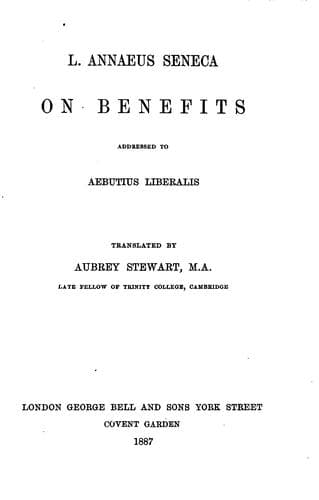
L. Annaeus Seneca on BenefitsSeneca, Lucius Annaeus
Philosophy
L. Annaeus Seneca on Benefits
Seneca, Lucius Annaeus
Benevolence; Classical literature; Conduct of life; Essays
XVIII. "You render me liable to an infinite debt of gratitude," says our
opponent, "when you say 'even to those who have given any thing to our
relations,' so fix some limit. He who bestows a benefit upon the son,
according to you, bestows it likewise upon the father: this is the first
question I wish to raise. In the next place I should like to have a
clear definition of whether a benefit, if it be bestowed upon your
friend's father as well as upon himself, is bestowed also upon his
brother? or upon his uncle? or his grandfather? or his wife and his
father-in-law? tell me where I am to stop, how far I am to follow out
the pedigree of the family?"
SENECA. If I cultivate your land, I bestow a benefit upon you; if I
extinguish your house when burning, or prop it so as to save it from
falling, I shall bestow a benefit upon you; if I heal your slave, I
shall charge it to you; if I save your son's life, will you not thereby
receive a benefit from me?
XIX. THE ADVERSARY. Your instances are not to the purpose, for he who
cultivates my land, does not benefit the land, but me; he who props my
house so that it does not fall, does this service to me, for the house
itself is without feeling, and as it has none, it is I who am indebted
to him; and he who cultivates my land does so because he wishes to
oblige me, not to oblige the land. I should say the same of a slave; he
is a chattel owned by me; he is saved for my advantage, therefore I am
indebted for him. My son is himself capable of receiving a benefit; so
it is he who receives it; I am gratified at a benefit which comes so
near to myself, but am not laid under any obligation.
SE. Still I should like you, who say that you are under no obligation,
to answer me this. The good health, the happiness, and the inheritance
of a son are connected with his father; his father will be more happy if
he keeps his son safe, and more unhappy if he loses him. What follows,
then? when a man is made happier by me and is freed from the greatest
danger of unhappiness, does he not receive a benefit?
AD. No, because there are some things which are bestowed upon others,
and yet flow from them so as to reach ourselves; yet we must ask the
person upon whom it was bestowed for repayment; as for example, money
must be sought from the man to whom it was lent, although it may,
by some means, have come into my hands. There is no benefit whose
advantages do not extend to the receiver's nearest friends, and
sometimes even to those less intimately connected with him; yet we do
not enquire whither the benefit has proceeded from him to whom it was
first given, but where it was first placed. You must demand repayment
from the defendant himself personally.
Public-domain text, read in full here on John Shaqi.
Reviews
Reviews
No reviews yet
Be the first to share your thoughts on this work.
Elsewhere in the archive
Join the Discussion
Join the discussion
Sign in to leave a comment or review.
Sign InorCreate an account