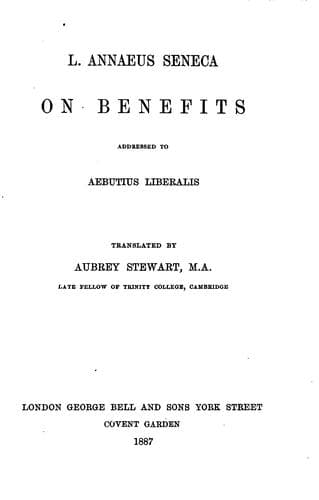
L. Annaeus Seneca on BenefitsSeneca, Lucius Annaeus
Philosophy
L. Annaeus Seneca on Benefits
Seneca, Lucius Annaeus
Benevolence; Classical literature; Conduct of life; Essays
XVII. The day would not be long enough for me to enumerate those who
have pushed their ingratitude so far as to ruin their native land.
It would be as vast a task to mention how often the state has been
ungrateful to its best and most devoted lovers, although it has done no
less wrong than it has suffered. It sent Camillus and Scipio into exile;
even after the death of Catiline it exiled Cicero, destroyed his house,
plundered his property, and did everything which Catiline would
have done if victorious; Rutilius found his virtue rewarded with a
hiding-place in Asia; to Cato the Roman people refused the praetorship,
and persisted in refusing the consulship. We are ungrateful in public
matters; and if every man asks himself, you will find that there is
no one who has not some private ingratitude to complain of. Yet it is
impossible that all men should complain, unless all were deserving of
complaint, therefore all men are ungrateful. Are they ungrateful
alone? nay, they are also all covetous, all spiteful, and all cowardly,
especially those who appear daring; and, besides this, all men fawn upon
the great, and all are impious. Yet you need not be angry with them;
pardon them, for they are all mad. I do not wish to recall you to what
is not proved, or to say, "See how ungrateful is youth! what young man,
even if of innocent life, does not long for his father's death? even if
moderate in his desires, does not look forward to it? even if dutiful,
does not think about it? How few there are who fear the death even of
the best of wives, who do not even calculate the probabilities of it.
Pray, what litigant, after having been successfully defended, retains
any remembrance of so great a benefit for more than a few days?" All
agree that no one dies without complaining. Who on his last day dares to
say,
"I've lived, I've done the task which Fortune set me."
Who does not leave the world with reluctance, and with lamentations? Yet
it is the part of an ungrateful man not to be satisfied with the past.
Your days will always be few if you count them. Reflect that length
of time is not the greatest of blessings; make the best of your time,
however short it may be; even if the day of your death be postponed,
your happiness will not be increased, for life is merely made longer,
not pleasanter, by delay. How much better is it to be thankful for the
pleasures which one has received, not to reckon up the years of others,
but to set a high value upon one's own, and score them to one's credit,
saying, "God thought me worthy of this; I am satisfied with it; he might
have given me more, but this, too, is a benefit." Let us be grateful
towards both gods and men, grateful to those who have given us anything,
and grateful even to those who have given anything to our relatives.
Public-domain text, read in full here on John Shaqi.
Reviews
Reviews
No reviews yet
Be the first to share your thoughts on this work.
Elsewhere in the archive
Join the Discussion
Join the discussion
Sign in to leave a comment or review.
Sign InorCreate an account