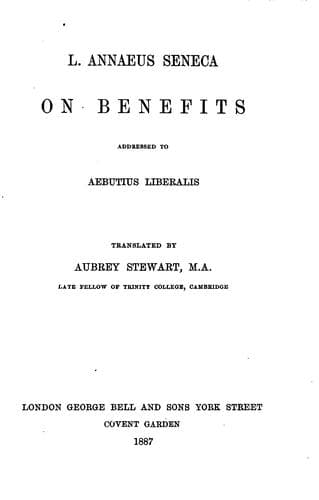
L. Annaeus Seneca on BenefitsSeneca, Lucius Annaeus
Philosophy
L. Annaeus Seneca on Benefits
Seneca, Lucius Annaeus
Benevolence; Classical literature; Conduct of life; Essays
However, if I were to lay aside the bickering of dialogue, and answer
you as a lawyer, I should say that you ought to consider the intention
of the giver, you must regard his benefit as bestowed upon the person
upon whom he meant to bestow it. If he did it in honour of the father,
then the father received the benefit; if he thought only of the son,
then the father is not laid under any obligation: by the benefit which
was conferred upon the son, even though the father derives pleasure from
it. Should he, however, have an opportunity, he will himself wish to
give you something, yet not as though he were forced to repay a debt,
but rather as if he had grounds for beginning an exchange of favours.
No return for a benefit ought to be demanded from the father of the
receiver; if he does you any kindness in return for it, he should be
regarded as, a righteous man, but not as a grateful one. For there is no
end to it; if I bestow a benefit on the receiver's father, do I likewise
bestow it upon his mother, his grandfather, his maternal uncle, his
children, relations, friends, slaves, and country? Where, then, does
a benefit begin to stop? for there follows it this endless chain of
people, to whom it is hard to assign bounds, because they join it by
degrees, and are always creeping on towards it.
XX. A common question is, "Two brothers are at variance. If I save the
life of one, do I confer a benefit upon the other, who will be sorry
that his hated brother did not perish?" There can be no doubt that it is
a benefit to do good to a man, even against that man's will, just as he,
who against his own will does a man good, does not bestow a benefit upon
him. "Do you," asks our adversary, "call that by which he is displeased
and hurt a benefit?" Yes; many benefits have a harsh and forbidding
appearance, such as cutting or burning to cure disease, or confining
with chains. We must not consider whether a man is grieved at receiving
a benefit, but whether he ought to rejoice: a coin is not bad because it
is refused by a savage who is unacquainted with its proper stamp. A man
receives a benefit even though he hates what is done, provided that it
does him good, and that the giver bestowed it in order to do him good.
It makes no difference if he receives a good thing in a bad spirit.
Consider the converse of this. Suppose that a man hates his brother,
though it is to his advantage to have a brother, and I kill this
brother, this is not a benefit, though he may say that it is, and be
glad of it. Our most artful enemies are those whom we thank for the
wrongs which they do us.
Public-domain text, read in full here on John Shaqi.
Reviews
Reviews
No reviews yet
Be the first to share your thoughts on this work.
Elsewhere in the archive
Join the Discussion
Join the discussion
Sign in to leave a comment or review.
Sign InorCreate an account