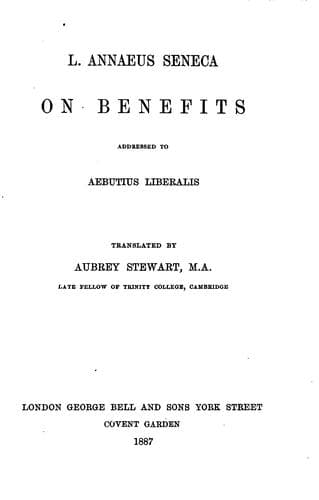
L. Annaeus Seneca on BenefitsSeneca, Lucius Annaeus
Philosophy
L. Annaeus Seneca on Benefits
Seneca, Lucius Annaeus
Benevolence; Classical literature; Conduct of life; Essays
"I understand; a thing which does good is a benefit, a thing which does
harm is not a benefit. Now I will suggest to you an act which neither
does good nor harm, and yet is a benefit. Suppose that I find the corpse
of some one's father in a wilderness, and bury it, then I certainly
have done him no good, for what difference could it make to him in what
manner his body decayed? Nor have I done any good to his son, for what
advantage does he gain by my act?" I will tell you what he gains. He has
by my means performed a solemn and necessary rite; I have performed a
service for his father which he would have wished, nay, which it would
have been his duty to have performed himself. Yet this act is not a
benefit, if I merely yielded to those feelings of pity and kindliness
which would make me bury any corpse whatever, but only if I recognized
this body, and buried it, with the thought in my mind that I was doing
this service to the son; but, by merely throwing earth over a dead
stranger, I lay no one under an obligation for an act performed on
general principles of humanity.
It may be asked, "Why are you so careful in inquiring upon whom you
bestow benefits, as though some day you meant to demand repayment of
them? Some say that repayment should never be demanded; and they give
the following reasons. An unworthy man will not repay the benefit which
he has received, even if it be demanded of him, while a worthy man will
do so of his own accord. Consequently, if you have bestowed it upon a
good man, wait; do not outrage him by asking him for it, as though of
his own accord he never would repay it. If you have bestowed it upon a
bad man, suffer for it, but do not spoil your benefit by turning it
into a loan. Moreover the law, by not authorizing you, forbids you,
by implication, to demand the repayment of a benefit." All this is
nonsense. As long as I am in no pressing need, as long as I am
not forced by poverty, I will lose my benefits rather than ask for
repayment; but if the lives of my children were at stake, if my wife
were in danger, if my regard for the welfare of my country and for
my own liberty were to force me to adopt a course which I disliked, I
should overcome my delicacy, and openly declare that I had done all that
I could to avoid the necessity of receiving help from an ungrateful man;
the necessity of obtaining repayment of one's benefit will in the end
overcome one's delicacy about asking for it. In the next place, when I
bestow a benefit upon a good man, I do so with the intention of never
demanding repayment, except in case of absolute necessity.
Public-domain text, read in full here on John Shaqi.
Reviews
Reviews
No reviews yet
Be the first to share your thoughts on this work.
Elsewhere in the archive
Join the Discussion
Join the discussion
Sign in to leave a comment or review.
Sign InorCreate an account