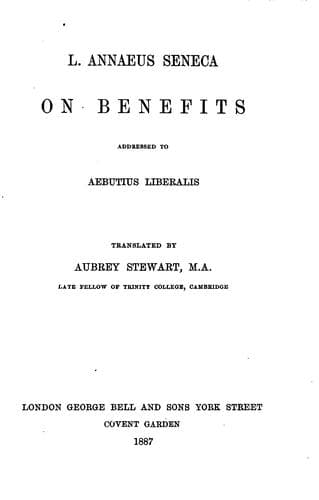
L. Annaeus Seneca on BenefitsSeneca, Lucius Annaeus
Philosophy
L. Annaeus Seneca on Benefits
Seneca, Lucius Annaeus
Benevolence; Classical literature; Conduct of life; Essays
XXI. "But," argues he, "by not authorizing you, the law forbids you to
exact repayment." There are many things which are not enforced by any
law or process, but which the conventions of society, which are stronger
than any law, compel us to observe. There is no law forbidding us to
divulge our friend's secrets; there is no law which bids us keep faith
even with an enemy; pray what law is there which binds us to stand by
what we have promised? There is none. Nevertheless I should remonstrate
with one who did not keep a secret, and I should be indignant with one
who pledged his word and broke it. "But," he argues, "you are turning a
benefit into a loan." By no means, for I do not insist upon repayment,
but only demand it; nay, I do not even demand it, but remind my friend
of it. Even the direst need will not bring me to apply for help to one
with whom I should have to undergo a long struggle.
If there be any one so ungrateful that it is not sufficient to remind
him of his debt, I should pass him over, and think that he did not
deserve to be made grateful by force. A money-lender does not demand
repayment from his debtors if he knows they have become bankrupt, and,
to their shame, have nothing but shame left to lose; and I, like him,
should pass over those who are openly and obstinately ungrateful, and
would demand repayment only from those who were likely to give it me,
not from those from whom I should have to extort it by force.
XXII. There are many who cannot deny that they have received a benefit,
yet cannot return it--men who are not good enough to be termed grateful,
nor yet bad enough to be termed ungrateful; but who are dull and
sluggish, backward debtors, though not defaulters. Such men as these I
should not ask for repayment, but forcibly remind them of it, and, from
a state of indifference, bring them back to their duty. They would at
once reply, "Forgive me; I did not know, by Hercules, that you missed
this, or I would have offered it of my own accord, I beg that you will
not think me ungrateful; I remember your goodness to me." Why need I
hesitate to make such men as these better to themselves and to me? I
would prevent any one from doing wrong, if I were able; much more would
I prevent a friend, both lest he should do wrong, and lest he should
do wrong to me in particular. I bestow a second benefit upon him by not
permitting him to be ungrateful; and I should not reproach him harshly
with what I had done for him, but should speak as gently as I could. In
order to afford him an opportunity of returning my kindness, I
should refresh his remembrance of it, and ask for a benefit; he would
understand that I was asking for repayment. Sometimes I would make use
of somewhat severe language, if I had any hope that by it he might be
amended; though I would not irritate a hopelessly ungrateful man, for
fear that I might turn him into an enemy. If we spare the ungrateful
even the affront of reminding them of their conduct, we shall render
Public-domain text, read in full here on John Shaqi.
Reviews
Reviews
No reviews yet
Be the first to share your thoughts on this work.
Elsewhere in the archive
Join the Discussion
Join the discussion
Sign in to leave a comment or review.
Sign InorCreate an account