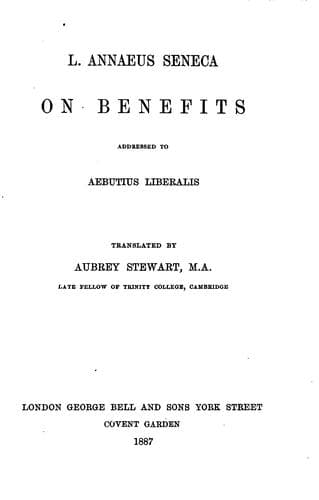
L. Annaeus Seneca on BenefitsSeneca, Lucius Annaeus
Philosophy
L. Annaeus Seneca on Benefits
Seneca, Lucius Annaeus
Benevolence; Classical literature; Conduct of life; Essays
sighed or made a wry face while he gave it; if he thought that he was
throwing it away rather than giving it, if he gave it to please himself,
or to please any one except me, the receiver; if he persistently makes
himself offensive by boasting of what he has done, if he brags of his
gift everywhere, and makes it a misery to me, then indeed the benefit
remains in my hands, but I owe him nothing for it, just as sums of money
to which a creditor has no legal right are owed to him, but cannot be
claimed by him.
V. Though you have bestowed a benefit upon me, yet you have since
done me a wrong; the benefit demanded gratitude, the wrong required
vengeance: the result is that I do not owe you gratitude, nor do you
owe me compensation--each is cancelled by the other. When we say, "I
returned him his benefit," we do not mean that we restored to him the
very thing which we had received, but something else in its place. To
return is to give back one thing instead of another, because, of course,
in all repayment it is not the thing itself, but its equivalent which
is returned. We are said to have returned money even though we count out
gold pieces instead of silver ones, or even if no money passes between
us, but the transaction be effected verbally by the assignment of a
debt.
I think I see you say, "You are wasting your time; of what use is it
to me to know whether what I do not owe to another still remains in my
hands or not? These are like the ingenious subtleties of the lawyers,
who declare that one cannot acquire an inheritance by prescription,
but can only acquire those things of which the inheritance consists, as
though there were any difference between the heritage and the things of
which it consists. Rather decide this point for me, which may be of
use. If the same man confers a benefit upon me, and afterwards does me
a wrong, is it my duty to return the benefit to him, and nevertheless to
avenge myself upon him, having, as it were, two distinct accounts open
with him, or to mix them both together, and do nothing, leaving the
benefit to be wiped out by the injury, the injury by the benefit? I see
that the former course is adopted by the law of the land; you know
best what the law may be among you Stoic philosophers in such a case. I
suppose that you keep the action which I bring against another distinct
from that which he Strings against me, and the two processes are not
merged into one? For instance, if a man entrusts me with money, and
afterwards robs me, I shall bring an action against him for theft, and
he will bring one against me for unlawfully detaining his property?"
Public-domain text, read in full here on John Shaqi.
Reviews
Reviews
No reviews yet
Be the first to share your thoughts on this work.
Elsewhere in the archive
Join the Discussion
Join the discussion
Sign in to leave a comment or review.
Sign InorCreate an account