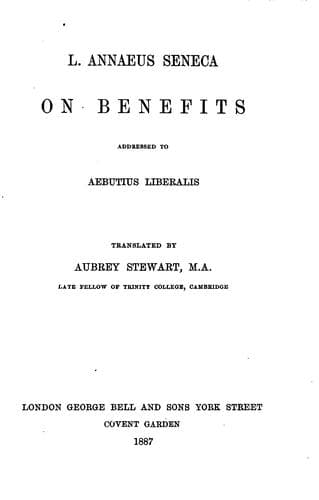
L. Annaeus Seneca on BenefitsSeneca, Lucius Annaeus
Philosophy
L. Annaeus Seneca on Benefits
Seneca, Lucius Annaeus
Benevolence; Classical literature; Conduct of life; Essays
VI. The cases which you have mentioned, my Liberalis, come under
well-established laws, which it is necessary for us to follow. One law
cannot be merged in another: each one proceeds its own way. There is a
particular action which deals with deposits just as there is one which
deals with theft. A benefit is subject to no law; it depends upon my
own arbitration. I am at liberty to contrast the amount of good or
harm which any one may have done me, and then to decide which of us is
indebted to the other. In legal processes we ourselves have no power, we
must go whither they lead us; in the case of a benefit the supreme
power is mine, I pronounce sentence. Consequently I do not separate or
distinguish between benefits and wrongs, but send them before the same
judge. Unless I did so, you would bid me love and hate, give thanks and
make complaints at the same time, which human nature does not admit of.
I would rather compare the benefit and the injury with one another, and
see whether there were any balance in my favour. If anybody puts lines
of other writing upon my manuscript he conceals, though he does not take
away, the letters which were there before, and in like manner a wrong
coming after a benefit does not allow it to be seen.
VII. Your face, by which I have agreed to be guided, now becomes
wrinkled with frowns, as though I were straying too widely from the
subject. You seem to say to me:
"Why steer to seaward?
Hither bend thy course,
Hug close the shore..."
I do hug it as close as possible. So now, if you think that we have
dwelt sufficiently upon this point, let us proceed to the consideration
of the next--that is, whether we are at all indebted to any one who
does us good without wishing to do so. I might have expressed this
more clearly, if it were not right that the question should be somewhat
obscurely stated, in order that by the distinction immediately following
it may be shown that we mean to investigate the case both of him who
does us good against his will, and that of him who does us good without
knowing it. That a man who does us good by acting under compulsion does
not thereby lay us under any obligation, is so clear, that no words
are needed to prove it. Both this question, and any other of the like
character which may be raised, can easily be settled if in each case we
bear in mind that, for anything to be a benefit, it must reach us in the
first place through some thought, and secondly through the thought of a
friend and well-wisher. Therefore we do not feel any gratitude towards
rivers, albeit they may bear large ships, afford an ample and unvarying
stream for the conveyance of merchandise, or flow beauteously and full
of fish through fertile fields. No one conceives himself to be indebted
for a benefit to the Nile, any more than he would owe it a grudge if its
waters flooded his fields to excess, and retired more slowly than usual;
the wind does not bestow benefits, gentle and favorable though it
Public-domain text, read in full here on John Shaqi.
Reviews
Reviews
No reviews yet
Be the first to share your thoughts on this work.
Elsewhere in the archive
Join the Discussion
Join the discussion
Sign in to leave a comment or review.
Sign InorCreate an account