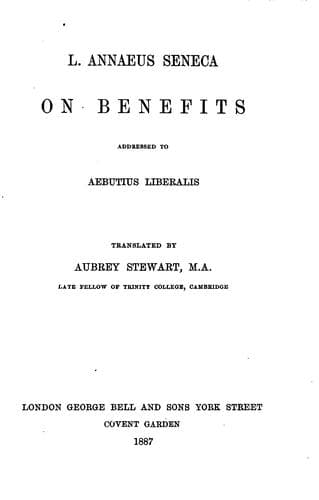
L. Annaeus Seneca on BenefitsSeneca, Lucius Annaeus
Philosophy
L. Annaeus Seneca on Benefits
Seneca, Lucius Annaeus
Benevolence; Classical literature; Conduct of life; Essays
IX. In order that I may be grateful, I must wish to do what my
benefactor must have wished in order that he might bestow a benefit. Can
anything be more unjust than to bear a grudge against a person who may
have trodden upon one's foot in a crowd, or splashed one, or pushed one
the way which one did not wish to go? Yet it was by his act that we were
injured, and we only refrain from complaining of him, because he did not
know what he was doing. The same reason makes it possible for men to do
us good without conferring benefits upon us, or to harm us without doing
us wrong, because it is intention which distinguishes our friends
from our enemies. How many have been saved from service in the army by
sickness! Some men have been saved from sharing the fall of their house,
by being brought up upon their recognizances to a court of law by their
enemies; some have been saved by ship-wreck from falling into the hands
of pirates; yet we do not feel grateful to such things, because chance
has no feeling of the service it renders, nor are we grateful to our
enemy, though his lawsuit, while it harassed and detained us, still
saved our lives. Nothing can be a benefit which does not proceed from
good will, and which is not meant as such by the giver. If any one
does me a service, without knowing it, I am under no obligation to him;
should he do so, meaning to injure me, I shall imitate his conduct.
X. Let us turn our attention to the first of these. Can you desire me to
do anything to express my gratitude to a man who did nothing in order to
confer a benefit upon me? Passing on to the next, do you wish me to show
my gratitude to such a man, and of my own will to return to him what I
received from him against his will? What am I to say of the third, he
who, meaning to do an injury, blunders into bestowing a benefit? That
you should have wished to confer a benefit upon me is not sufficient
to render me grateful; but that you should have wished not to do so is
enough to set me free from any obligation to you. A mere wish does not
constitute a benefit; and just as the best and heartiest wish is not a
benefit when fortune prevents its being carried into effect, neither is
what fortune bestows upon us a benefit, unless good wishes preceded
it. In order to lay me under an obligation, you must not merely do me a
service, but you must do so intentionally.
Public-domain text, read in full here on John Shaqi.
Reviews
Reviews
No reviews yet
Be the first to share your thoughts on this work.
Elsewhere in the archive
Join the Discussion
Join the discussion
Sign in to leave a comment or review.
Sign InorCreate an account