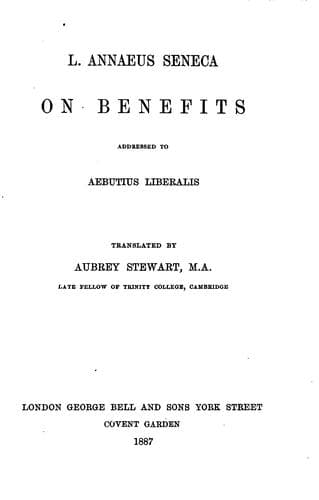
L. Annaeus Seneca on BenefitsSeneca, Lucius Annaeus
Philosophy
L. Annaeus Seneca on Benefits
Seneca, Lucius Annaeus
Benevolence; Classical literature; Conduct of life; Essays
may be, nor does wholesome and useful food; for he who would bestow a
benefit upon me, must not only do me good, but must wish to do so. No
obligation can therefore be incurred towards dumb animals; yet how many
men have been saved from peril by the swiftness of a horse!--nor
yet towards trees--yet how many sufferers from summer heat have been
sheltered by the thick foliage of a tree! What difference can it make,
whether I have profited by the act of one who did not know that he was
doing me good, or one who could not know it, when in each case the will
to do me good was wanting? You might as well bid me be grateful to a
ship, a carriage, or a lance for saving me from danger, as bid me be
grateful to a man who may have done me good by chance, but with no more
intention of doing me good than those things could have.
VIII. Some men may receive benefits without knowing it, but no man can
bestow them without knowing it. Many sick persons have been cured by
chance circumstances, which do not therefore become specific remedies;
as, for instance, one man was restored to health by falling into a river
during very cold weather, as another was set free from a quartan fever
by means of a flogging, because the sudden terror turned his attention
into a new channel, so that the dangerous hours passed unnoticed. Yet
none of these are remedies, even though they may have been
successful; and in like manner some men do us good, though they are
unwilling--indeed, because they are unwilling to do so--yet we need not
feel grateful to them as though we had received a benefit from them,
because fortune has changed the evil which they intended into good. Do
you suppose that I am indebted to a man who strikes my enemy with a blow
which he aimed at me, who would have injured me had he not missed his
mark? It often happens that by openly perjuring himself a man makes even
trustworthy witnesses disbelieved, and renders his intended victim an
object of compassion, as though he were being ruined by a conspiracy.
Some have been saved by the very power which was exerted to crush
them, and judges who would have condemned a man by law, have refused
to condemn him by favour. Yet they did not confer a benefit upon the
accused, although they rendered him a service, because we must
consider at what the dart was aimed, not what it hits, and a benefit
is distinguished from an injury not by its result, but by the spirit in
which it was meant. By contradicting himself, by irritating the judge by
his arrogance, or by rashly allowing his whole case to depend upon the
testimony of one witness, my opponent may have saved my cause. I do not
consider whether his mistakes benefited me or not, for he wished me ill.
Public-domain text, read in full here on John Shaqi.
Reviews
Reviews
No reviews yet
Be the first to share your thoughts on this work.
Elsewhere in the archive
Join the Discussion
Join the discussion
Sign in to leave a comment or review.
Sign InorCreate an account