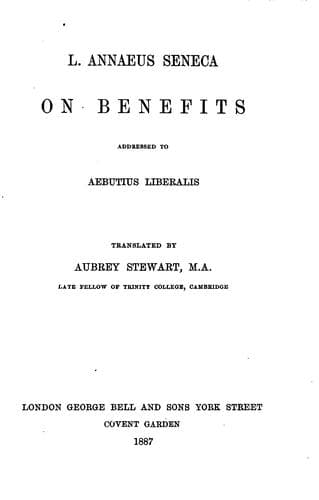
L. Annaeus Seneca on BenefitsSeneca, Lucius Annaeus
Philosophy
L. Annaeus Seneca on Benefits
Seneca, Lucius Annaeus
Benevolence; Classical literature; Conduct of life; Essays
XXII. "Well," says he "let them stop, if it be possible." What you say
is this:--"Let all those heavenly bodies, placed as they are at vast
distances from each other, and arranged to preserve the balance of the
universe, leave their appointed posts: let sudden confusion arise,
so that constellations may collide with constellations, that the
established harmony of all things may be destroyed and the works of God
be shaken into ruin; let the whole frame of the rapidly moving heavenly
bodies abandon in mid career those movements which we were assured would
endure for ages, and let those which now by their regular advance and
retreat keep the world at a moderate temperature, be instantly consumed
by fire, so that instead of the infinite variety of the seasons all may
be reduced to one uniform condition; let fire rage everywhere, followed
by dull night, and let the bottomless abyss swallow up all the gods." Is
it worth while to destroy all this merely in order to refute you? Even
though you do not wish it, they do you good, and they wheel in their
courses for your sake, though their motion may be due to some earlier
and more important cause.
XXIII. Besides this, the gods act under no external constraint, but
their own will is a law to them for all time. They have established an
order which is not to be changed, and consequently it is impossible that
they should appear to be likely to do anything against their will, since
they wish to continue doing whatever they cannot cease from doing, and
they never regret their original decision, No doubt it is impossible for
them to stop short, or to desert to the other side, but it is so for no
other reason than that their own force holds them to their purpose. It
is from no weakness that they persevere; no, they have no mind to leave
the best course, and by this it is fated that they should proceed. When,
at the time of the original creation, they arranged the entire universe,
they paid attention to us as well as to the rest, and took thought about
the human race; and for this reason we cannot suppose that it is merely
for their own pleasure that they move in their orbits and display their
work since we also are a part of that work. We are, therefore; under
an obligation to the sun and moon and the rest of the heavenly host,
because, although they may rise in order to bestow more important
benefits than those which we receive from them, yet they do bestow these
upon us as they pass on their way to greater things. Besides this, they
assist us of set purpose, and, therefore, lay us under an obligation,
because we do not in their case stumble by chance upon a benefit
bestowed by one who knew not what he was doing, but they knew that we
should receive from them the advantages which we do; so that, though
they may have some higher aim, though the result of their movements may
be something of greater importance than the preservation of the human
Public-domain text, read in full here on John Shaqi.
Reviews
Reviews
No reviews yet
Be the first to share your thoughts on this work.
Elsewhere in the archive
Join the Discussion
Join the discussion
Sign in to leave a comment or review.
Sign InorCreate an account