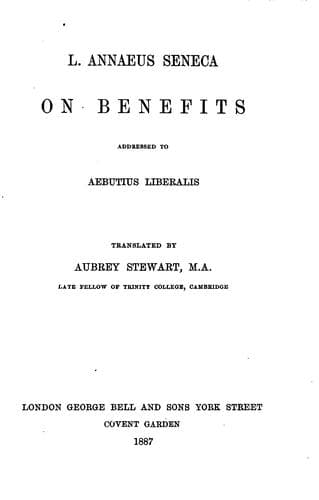
L. Annaeus Seneca on BenefitsSeneca, Lucius Annaeus
Philosophy
L. Annaeus Seneca on Benefits
Seneca, Lucius Annaeus
Benevolence; Classical literature; Conduct of life; Essays
race, yet from the beginning thought has been directed to our comforts,
and the scheme of the world has been arranged in a fashion which proves
that our interests were neither their least nor last concern. It is our
duty to show filial love for our parents, although many of them had no
thought of children when they married. Not so with the gods: they cannot
but have known what they were doing when they furnished mankind with
food and comforts. Those for whose advantage so much was created, could
not have been created without design. Nature conceived the idea of us
before she formed us, and, indeed, we are no such trifling piece of work
as could have fallen from her hands unheeded. See how great privileges
she has bestowed upon us, how far beyond the human race the empire of
mankind extends; consider how widely she allows us to roam, not having
restricted us to the land alone, but permitted us to traverse every part
of herself; consider, too, the audacity of our intellect, the only one
which knows of the gods or seeks for them, and how we can raise our mind
high above the earth, and commune with those divine influences: you will
perceive that man is not a hurriedly put together, or an unstudied piece
of work. Among her noblest products nature has none of which she can
boast more than man, and assuredly no other which can comprehend her
boast. What madness is this, to call the gods in question for their
bounty? If a man declares that he has received nothing when he is
receiving all the while, and from those who will always be giving
without ever receiving anything in return, how will he be grateful to
those whose kindness cannot be returned without expense? and how great a
mistake is it not to be thankful to a giver, because he is good even to
him who disowns him, or to use the fact of his bounty being poured upon
us in an uninterrupted stream, as an argument to prove that he cannot
help bestowing it. Suppose that such men as these say, "I do not want
it," "Let him keep it to himself," "Who asks him for it?" and so forth,
with all the other speeches of insolent minds: still, he whose bounty
reaches you, although you say that it does not, lays you under an
obligation nevertheless; indeed, perhaps the greatest part of the
benefit which he bestows is that he is ready to give even when you are
complaining against him.
Public-domain text, read in full here on John Shaqi.
Reviews
Reviews
No reviews yet
Be the first to share your thoughts on this work.
Elsewhere in the archive
Join the Discussion
Join the discussion
Sign in to leave a comment or review.
Sign InorCreate an account