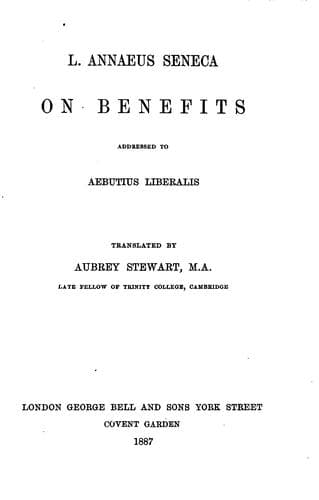
L. Annaeus Seneca on BenefitsSeneca, Lucius Annaeus
Philosophy
L. Annaeus Seneca on Benefits
Seneca, Lucius Annaeus
Benevolence; Classical literature; Conduct of life; Essays
XXIV. Do you not see how parents force children during their infancy
to undergo what is useful for their health? Though the children cry and
struggle, they swathe them and bind their limbs straight lest premature
liberty should make them grow crooked, afterwards instill into them a
liberal education, threatening those who are unwilling to learn, and
finally, if spirited young men do not conduct themselves frugally,
modestly, and respectably, they compel them to do so. Force and harsh
measures are used even to youths who have grown up and are their own
masters, if they, either from fear or from insolence, refuse to take
what is good for them. Thus the greatest benefits that we receive,
we receive either without knowing it, or against our will, from our
parents.
XXV. Those persons who are ungrateful and repudiate benefits, not
because they do not wish to receive them, but in order that they may not
be laid under an obligation for them, are like those who fall into the
opposite extreme, and are over grateful, who pray that some trouble or
misfortune may befall their benefactors to give them an opportunity
of proving how gratefully they remember the benefit which they have
received. It is a question whether they are right, and show a truly
dutiful feeling; their state of mind is morbid, like that of frantic
lovers who long for their mistress to be exiled, that they may accompany
her when she leaves her country forsaken by all her friends, or that she
may be poor in order that she may the more need what they give her, or
who long that she may be ill in order that they may sit by her bedside,
and who, in short, out of sheer love form the same wishes as her enemies
would wish for her. Thus the results of hatred and of frantic love are
very nearly the same; and these lovers are very like those who hope that
their friends may meet with difficulties which they may remove, and who
thus do a wrong that they may bestow a benefit, whereas it would have
been much better for them to do nothing, than by a crime to gain an
opportunity of doing good service. What should we say of a pilot who
prayed to the gods for dreadful storms and tempests, in order that
danger might make his skill more highly esteemed? what of a general who
should pray that a vast number of the enemy surround his camp, fill
the ditches by a sudden charge, tear down the rampart round his
panic-stricken army, and plant its hostile standards at the very gates,
in order that he might gain more glory by restoring his broken ranks and
shattered fortunes? All such men confer their benefits upon us by odious
means, for they beg the gods to harm those whom they mean to help, and
wish them to be struck down before they raise them up; it is a cruel
feeling, brought about by a distorted sense of gratitude, to wish evil
to befall one whom one is bound in honour to succour.
Public-domain text, read in full here on John Shaqi.
Reviews
Reviews
No reviews yet
Be the first to share your thoughts on this work.
Elsewhere in the archive
Join the Discussion
Join the discussion
Sign in to leave a comment or review.
Sign InorCreate an account