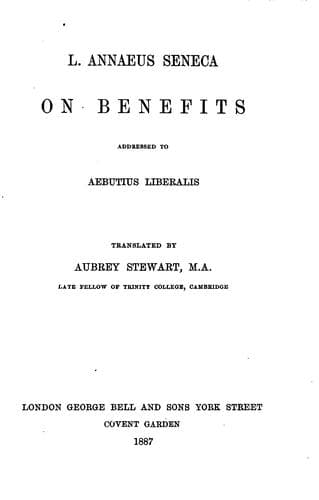
L. Annaeus Seneca on BenefitsSeneca, Lucius Annaeus
Philosophy
L. Annaeus Seneca on Benefits
Seneca, Lucius Annaeus
Benevolence; Classical literature; Conduct of life; Essays
XXXIX. Yet we must not condemn every thing which we find worthy of
blame, as, for instance, this wish about our friends which we have been
discussing, arises from a misdirected feeling of affection, and falls
into the very error which it strives to avoid, for the man is ungrateful
at the very time when he hurries to prove his gratitude. He prays aloud,
"May he fall into my power, may he need my influence, may not be able
to be safe and respectable without my aid, may he be so unfortunate that
whatever return I make to him may be regarded as a benefit." To the
gods alone he adds, "May domestic treasons encompass him, which can be
quelled by me alone; may some powerful and virulent enemy, some excited
and armed mob, assail him; may he be set upon by a creditor or an
informer."
XL. See, how just you are; you would never have wished any of these
misfortunes to befall him, if he had not bestowed a benefit upon you.
Not to speak of the graver guilt which you incur by returning evil for
good, you distinctly do wrong in not waiting for the fitting time for
each action, for it is as wrong to anticipate this as it is not to take
it when it comes. A benefit ought not always to be accepted, and ought
not in all cases to be returned. If you were to return it to me against
my will, you would be ungrateful, how much more ungrateful are you, if
you force me to wish for it? Wait patiently; why are you unwilling to
let my bounty abide with you? Why do you chafe at being laid under an
obligation? why, as though you were dealing with a harsh usurer, are you
in such a hurry to sign and seal an equivalent bond? Why do you wish me
to get into trouble? Why do you call upon the gods to ruin me? If this
is your way of returning a kindness, what would you do if you were
exacting repayment of a debt?
XLI. Above all, therefore, my Liberalis, let us learn to live calmly
under an obligation to others, and watch for opportunities of repaying
our debt without manufacturing them. Let us remember that this
anxiety to seize the first opportunity of setting ourselves free shows
ingratitude; for no one repays with good will that which he is unwilling
to owe, and his eagerness to get it out of his hands shows that he
regards it as a burden rather than as a favour. How much better and more
righteous is it to bear in mind what we owe to our friends, and to offer
repayment, not to obtrude it, nor to think ourselves too much indebted;
because a benefit is a common bond which connects two persons. Say "I do
not delay to repay your kindness to me; I hope that you will accept my
gratitude cheerfully. If irresistible fate hangs over either of us, and
destiny rules either that you must receive your benefit back again, or
that I must receive a second benefit, why then, of us two, let him give
that was wont to give. I am ready to receive it.
"'Tis not the part of Turnus to delay."
Public-domain text, read in full here on John Shaqi.
Reviews
Reviews
No reviews yet
Be the first to share your thoughts on this work.
Elsewhere in the archive
Join the Discussion
Join the discussion
Sign in to leave a comment or review.
Sign InorCreate an account