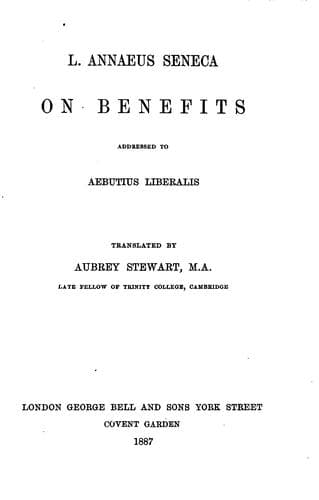
L. Annaeus Seneca on BenefitsSeneca, Lucius Annaeus
Philosophy
L. Annaeus Seneca on Benefits
Seneca, Lucius Annaeus
Benevolence; Classical literature; Conduct of life; Essays
That is the spirit which I shall show whenever the time comes; in the
meanwhile the gods shall be my witnesses.
XLII. I have noted in you, my Liberalis, and as it were touched with my
hand a feeling of fussy anxiety not to be behindhand in doing what is
your duty. This anxiety is not suitable to a grateful mind, which,
on the contrary, produces the utmost confidence in oneself, and which
drives away all trouble by the consciousness of real affection towards
one's benefactor. To say "Take back what you gave me," is no less
a reproach than to say "You are in my debt." Let this be the first
privilege of a benefit, that he who bestowed it may choose the time when
he will have it returned. "But I fear that men may speak ill of me." You
do wrong if you are grateful only for the sake of your reputation, and
not to satisfy your conscience. You have in this matter two judges, your
benefactor, whom you ought not, and yourself, whom you cannot deceive.
"But," say you, "if no occasion of repayment offers, am I always to
remain in his debt?" Yes; but you should do so openly, and willingly,
and should view with great pleasure what he has entrusted to you. If you
are vexed at not having yet returned a benefit, you must be sorry that
you ever received it; but if he deserved that you should receive a
benefit from him, why should he not deserve that you should long remain
in his debt?
XLIII. Those persons are much mistaken who regard it as a proof of a
great mind to make offers to give, and to fill many men's pockets and
houses with their presents, for sometimes these are due not to a great
mind, but to a great fortune; they do not know how far more great and
more difficult it sometimes is to receive than to lavish gifts. I must
disparage neither act; it is as proper to a noble heart to owe as to
receive, for both are of equal value when done virtuously; indeed, to
owe is the more difficult, because it requires more pains to keep a
thing safe than to give it away. We ought not therefore to be in a hurry
to repay, nor need we seek to do so out of due season, for to hasten to
make repayment at the wrong time is as bad as to be slow to do so at the
right time. My benefactor has entrusted his bounty to me: I ought not
to have any fears either on his behalf or on my own. He has a sufficient
security; he cannot lose it except he loses me--nay, not even if he
loses me. I have returned thanks to him for it--that is, I have requited
him. He who thinks too much about repaying a benefit must suppose that
his friend thinks too much about receiving repayment. Make no difficulty
about either course. If he wishes to receive his benefit back again,
let us return it cheerfully; if he prefers to leave it in our hands,
why should we dig up his treasure? why should we decline to be its
guardians? he deserves to be allowed to do whichever he pleases. As
for fame and reputation, let us regard them as matters which ought to
accompany, but which ought not to direct our actions.
Public-domain text, read in full here on John Shaqi.
Reviews
Reviews
No reviews yet
Be the first to share your thoughts on this work.
Elsewhere in the archive
Join the Discussion
Join the discussion
Sign in to leave a comment or review.
Sign InorCreate an account