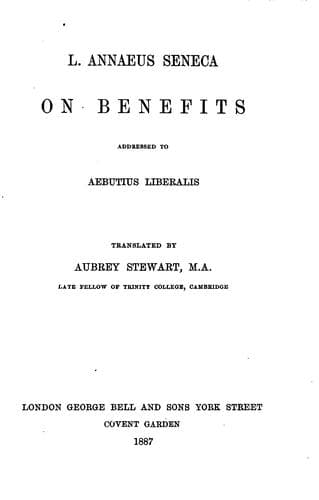
L. Annaeus Seneca on BenefitsSeneca, Lucius Annaeus
Philosophy
L. Annaeus Seneca on Benefits
Seneca, Lucius Annaeus
Benevolence; Classical literature; Conduct of life; Essays
BOOK VII.
I.
Be of good cheer, my Liberalis:
"Our port is close, and I will not delay,
Nor by digressions wander from the way."
This book collects together all that has been omitted, and in it, having
exhausted my subject, I shall consider not what I am to say, but what
there is which I have not yet said. If there be anything superfluous
in it, I pray you take it in good part, since it is for you that it is
superfluous. Had I wished to set off my work to the best advantage, I
ought to have added to it by degrees, and to have kept for the last that
part which would be eagerly perused even by a sated reader. However,
instead of this, I have collected together all that was essential in the
beginning; I am now collecting together whatever then escaped me; nor,
by Hercules, if you ask me, do I think that, after the rules which
govern our conduct have been stated, it is very much to the purpose to
discuss the other questions which have been raised more for the exercise
of our intellects than for the health of our minds. The cynic Demetrius,
who in my opinion was a great man even if compared with the greatest
philosophers, had an admirable saying about this, that one gained more
by having a few wise precepts ready and in common use than by learning
many without having them at hand. "The best wrestler," he would say, "is
not he who has learned thoroughly all the tricks and twists of the art,
which are seldom met with in actual wrestling, but he who has well and
carefully trained himself in one or two of them, and watches keenly for
an opportunity of practising them. It does not matter how many of them
he knows, if he knows enough to give him the victory; and so in
this subject of ours there are many points of interest, but few of
importance. You need not know what is the system of the ocean tides,
why each seventh year leaves its mark upon the human body, why the more
distant parts of a long portico do not keep their true proportion,
but seem to approach one another until at last the spaces between the
columns disappear, how it can be that twins are conceived separately,
though they are born together, whether both result from one, or each
from a separate act, why those whose birth was the same should have such
different fates in life, and dwell at the greatest possible distance
from one another, although they were born touching one another; it will
not do you much harm to pass over matters which we are not permitted to
know, and which we should not profit by knowing. Truths so obscure may
be neglected with impunity. [Footnote: The old saying, 'Truth lurks deep
in a well (or abyss).'] Nor can we complain that nature deals hardly
with us, for there is nothing which is hard to discover except those
things by which we gain nothing beyond the credit of having discovered
them; whatever things tend to make us better or happier are either
obvious or easily discovered. Your mind can rise superior to the
Public-domain text, read in full here on John Shaqi.
Reviews
Reviews
No reviews yet
Be the first to share your thoughts on this work.
Elsewhere in the archive
Join the Discussion
Join the discussion
Sign in to leave a comment or review.
Sign InorCreate an account