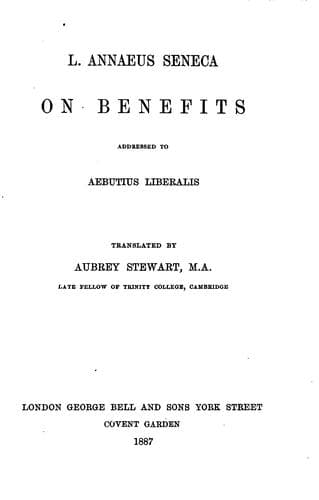
L. Annaeus Seneca on BenefitsSeneca, Lucius Annaeus
Philosophy
L. Annaeus Seneca on Benefits
Seneca, Lucius Annaeus
Benevolence; Classical literature; Conduct of life; Essays
X. What are you doing, Avarice? see how many things there are whose
price exceeds that of your beloved gold: all those which I have
mentioned are more highly esteemed and valued. I now wish to review your
wealth, those plates of gold and silver which dazzle our covetousness.
By Hercules, the very earth, while she brings forth upon the surface
every thing that is of use to us, has buried these, sunk them deep,
and rests upon them with her whole weight, regarding them as pernicious
substances, and likely to prove the ruin of mankind if brought into the
light of day. I see that iron is brought out of the same dark pits as
gold and silver, in order that we may lack neither the means nor the
reward of murder. Thus far we have dealt with actual substances; but
some forms of wealth deceive our eyes and minds alike. I see there
letters of credit, promissory notes, and bonds, empty phantoms of
property, ghosts of sick Avarice, with which she deceives our minds,
which delight in unreal fancies; for what are these things, and what are
interest, and account books, and usury, except the names of unnatural
developments of human covetousness? I might complain of nature for not
having hidden gold and silver deeper, for not having laid over it a
weight too heavy to be removed: but what are your documents, your sale
of time, your blood-sucking twelve per cent. interest? these are evils
which we owe to our own will, which flow merely from our perverted
habit, having nothing about them which can be seen or handled, mere
dreams of empty avarice. Wretched is he who can take pleasure in the
size of the audit book of his estate, in great tracts of land cultivated
by slaves in chains, in huge flocks and herds which require provinces
and kingdoms for their pasture ground, in a household of servants, more
in number than some of the most warlike nations, or in a private house
whose extent surpasses that of a large city! After he has carefully
reviewed all his wealth, in what it is invested, and on what it is
spent, and has rendered himself proud by the thoughts of it, let him
compare what he has with what he wants: he becomes a poor man at once.
"Let me go: restore me to those riches of mine. I know the kingdom of
wisdom, which is great and stable: I possess every thing, and in such a
manner that it belongs to all men nevertheless."
XI. When, therefore, Gaius Caesar offered him two hundred thousand
sesterces, he laughingly refused it, thinking it unworthy of himself to
boast of having refused so small a sum. Ye gods and goddesses, what a
mean mind must the emperor have had, if he hoped either to honour or to
corrupt him. I must here repeat a proof of his magnanimity. I have
heard that when he was expressing his wonder at the folly of Gaius at
supposing that he could be influenced by such a bribe, he said, "If
he meant to tempt me, he ought to have tried to do so by offering his
entire kingdom."
Public-domain text, read in full here on John Shaqi.
Reviews
Reviews
No reviews yet
Be the first to share your thoughts on this work.
Elsewhere in the archive
Join the Discussion
Join the discussion
Sign in to leave a comment or review.
Sign InorCreate an account