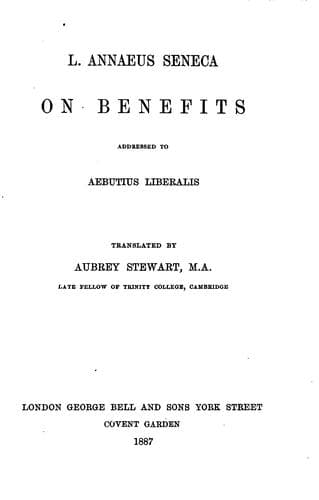
L. Annaeus Seneca on BenefitsSeneca, Lucius Annaeus
Philosophy
L. Annaeus Seneca on Benefits
Seneca, Lucius Annaeus
Benevolence; Classical literature; Conduct of life; Essays
XII. It is possible, then, to give something to the wise man, although
all things belong to the wise man. Similarly, though we declare that
friends have all things in common, it is nevertheless possible to give
something to a friend: for I have not everything in common with a friend
in the same manner as with a partner, where one part belongs to him,
and another to me, but rather as a father and a mother possess their
children in common when they have two, not each parent possessing one
child, but each possessing both. First of all I will prove that any
chance would-be partner of mine has nothing in common with me: and why?
Because this community of goods can only exist between wise men, who
are alone capable of friendship: other men can neither be friends nor
partners one to another. In the next place, things may be owned in
common in various ways. The knights' seats in the theatre belong to all
the Roman knights; yet of these the seat which I occupy becomes my own,
and if I yield it up to any one, although I only yield him a thing
which we own in common, still I appear to have given him something. Some
things belong to certain persons under particular conditions. I have
a place among the knights, not to sell, or to let, or to dwell in, but
simply to see the spectacle from, wherefore I do not tell an untruth
when I say that I have a place among the knights' seats. Yet if, when I
come into the theatre, the knights' seats are full, I both have a seat
there by right, because I have the privilege of sitting there, and I
have not a seat there, because my seat is occupied by those who share my
right to those places. Suppose that the same thing takes place between
friends; whatever our friend possesses, is common to us, but is the
property of him who owns it; I cannot make use of it against his will.
"You are laughing at me," say you; "if what belongs to my friend is
mine, I am able to sell it." You are not able; for you are not able to
sell your place among the knights' seats, and yet they are in common
between you and the other knights. Consequently, the fact that you
cannot sell a thing, or consume it, or exchange it for the better or the
worse does not prove that it is not yours; for that which is yours under
certain conditions is yours nevertheless.
XIII. I have received, but certainly not less. Not to detain you longer
than is necessary, a benefit can be no more than a benefit; but the
means employed to convey benefits may be both greater and more numerous.
I mean those things by which kindness expresses and gives vent to
itself, like lovers, whose many kisses and close embraces do not
increase their love but give it play.
XIV. The next question which arises has been thoroughly threshed out in
the former books, so here it shall only be touched on shortly; for the
arguments which have been used for other cases can be transferred to it.
Public-domain text, read in full here on John Shaqi.
Reviews
Reviews
No reviews yet
Be the first to share your thoughts on this work.
Elsewhere in the archive
Join the Discussion
Join the discussion
Sign in to leave a comment or review.
Sign InorCreate an account