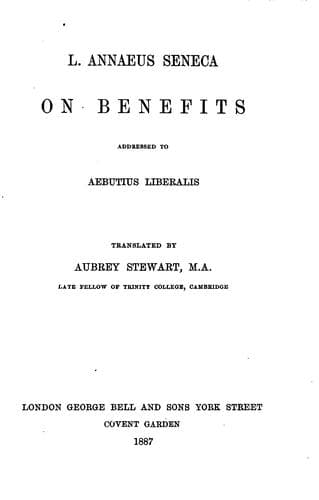
L. Annaeus Seneca on BenefitsSeneca, Lucius Annaeus
Philosophy
L. Annaeus Seneca on Benefits
Seneca, Lucius Annaeus
Benevolence; Classical literature; Conduct of life; Essays
XVI. If, however, you ask me what I really think, and wish me to give a
definite answer, I should say that the one party ought to consider his
benefit to have been returned, while the other ought to feel that he has
not returned it; the one should release his friend from the debt, the
other should hold himself bound to pay it; the one should say, "I have
received;" the other should answer, "I owe." In our whole investigation,
we ought to look entirely to the public good; we ought to prevent the
ungrateful having any excuses in which they can take refuge, and under
cover of which they can disown their debts. "I have done all in my
power," say you. Well, keep on doing so still. Do you suppose that our
ancestors were so foolish, as not to understand that it is most unjust
that the man who has wasted the money which he received from his
creditor on debauchery, or gambling, should be classed with one who has
lost his own property as well as that of others in a fire, by robbery,
or some sadder mischance? They would take no excuse, that men might
understand that they were always bound to keep their word; it was
thought better that even a good excuse should not be accepted from a few
persons, than that all men should be led to try to make excuses. You say
that you have done all in your power to repay your debt; this ought to
be enough for your friend, but not enough for you. He to whom you owe a
kindness, is unworthy of gratitude if he lets all your anxious care and
trouble to repay it go for nothing; and so, too, if your friend takes
your good will as a repayment, you are ungrateful if you are not all the
more eager to feel the obligation of the debt which he has forgiven you.
Do not snap up his receipt, or call witnesses to prove it; rather seek
opportunities for repaying not less than before; repay the one man
because he asks for repayment, the other because he forgives you your
debt; the one because he is good, the other because he is bad. You, need
not, therefore, think that you have anything to do with the question
whether a man be bound to repay the benefit which he has received from
a wise man, if that man has ceased to be wise and has turned into a bad
man. You would return a deposit which you had received from a wise man;
you would return a loan even to a bad man; what grounds have you for
not returning a benefit also? Because he has changed, ought he to change
you? What? if you had received anything from a man when healthy, would
you not return it to him when he was sick, though we always are more
bound to treat our friends with more kindness when they are ailing? So,
too, this man is sick in his mind; we ought to help him, and bear with
him; folly is a disease of the mind.
Public-domain text, read in full here on John Shaqi.
Reviews
Reviews
No reviews yet
Be the first to share your thoughts on this work.
Elsewhere in the archive
Join the Discussion
Join the discussion
Sign in to leave a comment or review.
Sign InorCreate an account