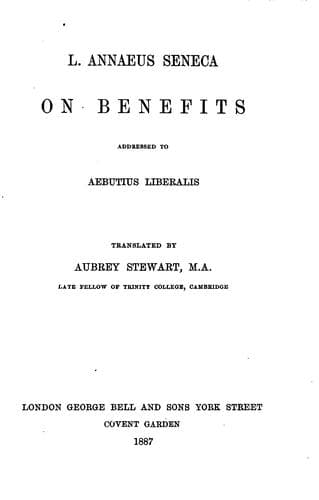
L. Annaeus Seneca on BenefitsSeneca, Lucius Annaeus
Philosophy
L. Annaeus Seneca on Benefits
Seneca, Lucius Annaeus
Benevolence; Classical literature; Conduct of life; Essays
XV. In short, suppose that when you are taken captive, I have borrowed
money, made over my property as security to my creditor, that I have
sailed in a stormy winter season along coasts swarming with pirates,
that I have braved all the perils which necessarily attend a voyage even
on a peaceful sea, that I have wandered through all wildernesses seeking
for those men whom all others flee from, and that when I have at length
reached the pirates, someone else has already ransomed you: will you
say that I have not returned your kindness? Even if during this voyage I
have lost by shipwreck the money that I had raised to save you, even if
I myself have fallen into the prison from which I sought to release you,
will you say that I have not returned your kindness? No, by Hercules!
the Athenians call Harmodius and Aristogiton, tyrannicides; the hand of
Mucius which he left on the enemy's altar was equivalent to the death
of Porsena, and valour struggling against fortune is always illustrious,
even if it falls short of accomplishing its design. He who watches
each opportunity as it passes, and tries to avail himself of one
after another, does more to show his gratitude than he whom the first
opportunity enabled to be grateful without any trouble whatever. "But,"
says our adversary, "he gave you two things, material help and kindly
feeling; you, therefore, owe him two." You might justly say this to one
who returns your kindly feeling without troubling himself further; this
man is really in your debt; but you cannot say so of one who wishes to
repay you, who struggles and leaves no stone unturned to do so; for,
as far as in him lies, he repays you in both kinds; in the next place,
counting is not always a true test, sometimes one thing is equivalent to
two; consequently so intense and ardent a wish to repay takes the place
of a material repayment. Indeed, if a feeling of gratitude has no value
in repaying a kindness without giving something material, then no one
can be grateful to the gods, whom we can repay by gratitude alone. "We
cannot," says our adversary, "give the gods anything else." Well, but
if I am not able to give this man, whose kindness I am bound to return,
anything beside my gratitude, why should that which is all that I can
bestow on a god be insufficient to prove my gratitude towards a man?
Public-domain text, read in full here on John Shaqi.
Reviews
Reviews
No reviews yet
Be the first to share your thoughts on this work.
Elsewhere in the archive
Join the Discussion
Join the discussion
Sign in to leave a comment or review.
Sign InorCreate an account