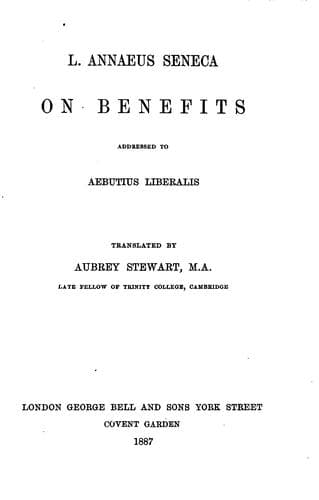
L. Annaeus Seneca on BenefitsSeneca, Lucius Annaeus
Philosophy
L. Annaeus Seneca on Benefits
Seneca, Lucius Annaeus
Benevolence; Classical literature; Conduct of life; Essays
XIX. "To return a thing," says our adversary, "is to hand it over to one
who can receive it. Why, if you owed some wine to any man, and he bade
you pour it into a net or a sieve, would you say that you had returned
it? or would you be willing to return it in such a way that in the act
of returning it was lost between you?" To return is to give that which
you owe back to its owner when he wishes for it. It is not my duty to
perform more than this; that he should possess what he has received
from me is a matter for further consideration; I do not owe him the
safe-keeping of his property, but the honourable payment of my debt,
and it is much better that he should not have it, than that I should
not return it to him. I would repay my creditor, even though he would
at once take what I paid him to the market; even if he deputed an
adulteress to receive the money from me, I would pay it to her; even
if he were to pour the coins which he receives into a loose fold of his
cloak, I would pay it. It is my business to return it to him, not to
keep it and save it for him after I have returned it; I am bound to take
care of his bounty when I have received it, but not when I have returned
it to him. While it remains with me, it must be kept safe; but when he
asks for it again I must give it to him, even though it slips out of his
hands as he takes it. I will repay a good man when it is convenient; I
will repay a bad man when he asks me to do so.
"You cannot," argues our adversary, "return him a benefit of the same
kind as that which you received; for you received it from a wise man,
and you are returning it to a fool." Do I not return to him such a
benefit, as he is now able to receive? It is not my fault if I return it
to him worse than I received it, the fault lies with him, and so, unless
he regains his former wisdom, I shall return it in such a form as he
in his fallen condition is able to receive. "But what," asks he, "if
he become not only bad, but savage and ferocious, like Apollodorus or
Phalaris, would you return even to such a man as this a benefit which
you had received from him?" I answer, Nature does not admit of so great
a change in a wise man. Men do not change from the best to the worst;
even in becoming bad, he would necessarily retain some traces of
goodness; virtue is never so utterly quenched as not to imprint on the
mind marks which no degradation can efface. If wild animals bred in
captivity escape into the woods, they still retain something of their
original tameness, and are as remote from the gentlest in the one
extreme as they are in the other from those which have always been wild,
and have never endured to be touched by man's hand. No one who has ever
applied himself to philosophy ever becomes completely wicked; his mind
becomes so deeply coloured with it, that its tints can never be entirely
spoiled and blackened. In the next place, I ask whether this man of
yours be ferocious merely in intent, or whether he breaks out into
Public-domain text, read in full here on John Shaqi.
Reviews
Reviews
No reviews yet
Be the first to share your thoughts on this work.
Elsewhere in the archive
Join the Discussion
Join the discussion
Sign in to leave a comment or review.
Sign InorCreate an account