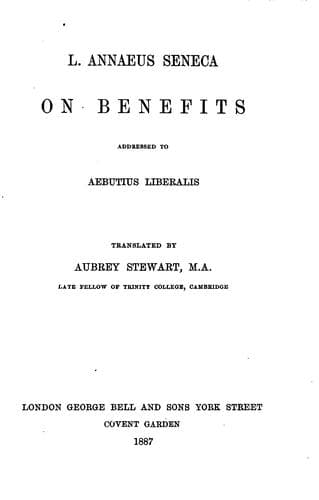
L. Annaeus Seneca on BenefitsSeneca, Lucius Annaeus
Philosophy
L. Annaeus Seneca on Benefits
Seneca, Lucius Annaeus
Benevolence; Classical literature; Conduct of life; Essays
actual outrages upon mankind? You have instanced the tyrants Apollodorus
and Phalaris; if the bad man restrains their evil likeness within
himself, why should I not return his benefit to him, in order to set
myself free from any further dealings with him? If, however, he not
only delights in human blood, but feeds upon it; if he exercises his
insatiable cruelty in the torture of persons of all ages, and his fury
is not prompted by anger, but by a sort of delight in cruelty, if he
cuts the throats of children before the eyes of their parents; if, not
satisfied with merely killing his victims, he tortures them, and not
only burns but actually roasts them; if his castle is always wet with
freshly shed blood; then it is not enough not to return his benefits.
All connexion between me and such a man has been broken off by his
destruction of the bonds of human society. If he had bestowed something
upon me, but were to invade my native country, he would have lost all
claim to my gratitude, and it would be counted a crime to make him any
return; if he does not attack my country, but is the scourge of his own;
if he has nothing to do with my nation, but torments and cuts to pieces
his own, then in the same manner such depravity, though it does not
render him my personal enemy, yet renders him hateful to me, and the
duty which I owe to the human race is anterior to and more important
than that which I owe to him as an individual.
XX. However, although this be so, and although I am freed from all
obligation towards him, from the moment when, by outraging all laws, he
rendered it impossible for any man to do him a wrong, nevertheless, I
think I ought to make the following distinction in dealing with him.
If my repayment of his benefit will neither increase nor maintain his
powers of doing mischief to mankind, and is of such a character that I
can return it to him without disadvantage to the public, I would return
it: for instance, I would save the life of his infant child; for what
harm can this benefit do to any of those who suffer from his cruelty?
But I would not furnish him with money to pay his bodyguard. If he
wishes for marbles, or fine clothes, the trappings of his luxury will
harm no one; but with soldiers and arms I would not furnish him. If he
demands, as a great boon, actors and courtesans and such things as will
soften his savage nature, I would willingly bestow them upon him. I
would not furnish him with triremes and brass-beaked ships of war, but I
would send him fast sailing and luxuriously-fitted vessels, and all
the toys of kings who take their pleasure on the sea. If his health was
altogether despaired of, I would by the same act bestow a benefit on all
men and return one to him; seeing that for such characters death is
the only remedy, and that he who never will return to himself, had best
leave himself. However, such wickedness as this is uncommon, and is
always regarded as a portent, as when the earth opens, or when fires
Public-domain text, read in full here on John Shaqi.
Reviews
Reviews
No reviews yet
Be the first to share your thoughts on this work.
Elsewhere in the archive
Join the Discussion
Join the discussion
Sign in to leave a comment or review.
Sign InorCreate an account