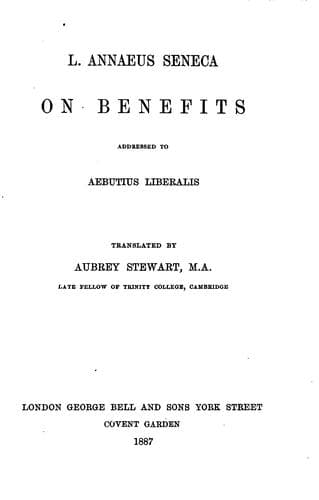
L. Annaeus Seneca on BenefitsSeneca, Lucius Annaeus
Philosophy
L. Annaeus Seneca on Benefits
Seneca, Lucius Annaeus
Benevolence; Classical literature; Conduct of life; Essays
XXVIII. Consider within yourself, whether you have always shown
gratitude to those to whom you owe it, whether no one's kindness has
ever been wasted upon you, whether you constantly bear in mind all the
benefits which you have received. You will find that those which you
received as a boy were forgotten before you became a man; that those
bestowed upon you as a young man slipped from your memory when you
became an old one. Some we have lost, some we have thrown away, some
have by degrees passed out of our sight, to some we have wilfully shut
our eyes. If I am to make excuses for your weakness, I must say in the
first place that human memory is a frail vessel, and is not large enough
to contain the mass of things placed in it; the more it receives, the
more it must necessarily lose; the oldest things in it give way to the
newest. Thus it comes to pass that your nurse has hardly any influence
with you, because the lapse of time has set the kindness which you
received from her at so great a distance; thus it is that you no longer
look upon your teacher with respect; and that now when you are busy
about your candidature for the consulate or the priesthood, you forget
those who supported you in your election to the quaestorship. If you
carefully examine yourself, perhaps you will find the vice of which
you complain in your own bosom; you are wrong in being angry with a
universal failing, and foolish also, for it is your own as well; you
must pardon others, that you may yourself be acquitted. You will make
your friend a better man by bearing with him, you will in all cases make
him a worse one by reproaching him. You can have no reason for rendering
him shameless; let him preserve any remnants of modesty which he may
have. Too loud reproaches have often dispelled a modesty which might
have borne good fruit. No man fears to be that which all men see that he
is; when his fault is made public, he loses his sense of shame.
XXIX. You say, "I have lost the benefit which I bestowed." Yet do we
say that we have lost what we consecrate to heaven, and a benefit well
bestowed, even though we get an ill return for it, is to be reckoned
among things consecrated. Our friend is not such a man as we hoped he
was; still, let us, unlike him, remain the same as we were. The loss did
not take place when he proved himself so; his ingratitude cannot be made
public without reflecting some shame upon us, since to complain of the
loss of a benefit is a sign that it was not well bestowed. As far as we
are able we ought to plead with ourselves on his behalf: "Perhaps he was
not able to return it, perhaps he did not know of it, perhaps he will
still do so." A wise and forbearing creditor prevents the loss of some
debts by encouraging his debtor and giving him time. We ought to do the
same, we ought to deal tenderly with a weakly sense of honour.
Public-domain text, read in full here on John Shaqi.
Reviews
Reviews
No reviews yet
Be the first to share your thoughts on this work.
Elsewhere in the archive
Join the Discussion
Join the discussion
Sign in to leave a comment or review.
Sign InorCreate an account