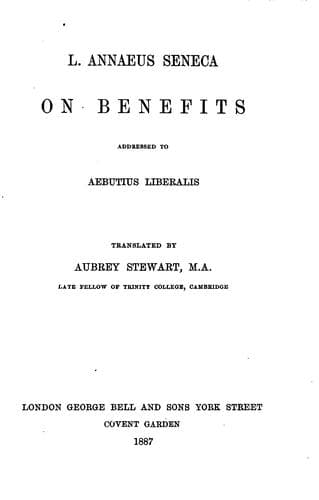
L. Annaeus Seneca on BenefitsSeneca, Lucius Annaeus
Philosophy
L. Annaeus Seneca on Benefits
Seneca, Lucius Annaeus
Benevolence; Classical literature; Conduct of life; Essays
XXX. "I have lost," say you, "the benefit which I bestowed." You are a
fool, and do not understand when your loss took place; you have indeed
lost it, but you did so when you gave it, the fact has only now come
to light. Even in the case of those benefits which appear to be lost,
gentleness will do much good; the wounds of the mind ought to be
handled as tenderly as those of the body. The string, which might be
disentangled by patience, is often broken by a rough pull. What is
the use of abuse, or of complaints? why do you overwhelm him with
reproaches? why do you set him free from his obligation? even if he
be ungrateful he owes you nothing after this. What sense is there in
exasperating a man on whom you have conferred great favours, so as out
of a doubtful friend to make a certain enemy, and one, too, who will
seek to support his own cause by defaming you, or to make men say, "I do
not know what the reason is that he cannot endure a man to whom he
owes so much; there must be something in the background?" Any man can
asperse, even if he does not permanently stain the reputation of his
betters by complaining of them; nor will any one be satisfied with
imputing small crimes to them, when it is only by the enormity of his
falsehood that he can hope to be believed.
XXXI. What a much better way is that by which the semblance of
friendship, and, indeed, if the other regains to his right mind,
friendship itself is preserved! Bad men are overcome by unwearying
goodness, nor does any one receive kindness in so harsh and hostile a
spirit as not to love good men even while he does them wrong, when they
lay him under the additional obligation of requiring no return for their
kindness. Reflect, then, upon this: you say, "My kindness has met with
no return, what am I to do? I ought to imitate the gods, those noblest
disposers of all events, who begin to bestow their benefits on those who
know them not, and persist in bestowing them on those who are ungrateful
for them. Some reproach them with neglect of us, some with injustice
towards us; others place them outside of their own world, in sloth and
indifference, without light, and without any functions; others declare
that the sun itself, to whom we owe the division of our times of labour
and of rest, by whose means we are saved from being plunged in the
darkness of eternal night; who, by his circuit, orders the seasons
of the year, gives strength to our bodies, brings forth our crops and
ripens our fruits, is merely a mass of stone, or a fortuitous collection
of fiery particles, or anything rather than a god. Yet, nevertheless,
like the kindest of parents, who only smile at the spiteful words of
their children, the gods do not cease to heap benefits upon those
who doubt from what source their benefits are derived, but continue
impartially distributing their bounty among all the peoples and nations
of the earth. Possessing only the power of doing good, they moisten
Public-domain text, read in full here on John Shaqi.
Reviews
Reviews
No reviews yet
Be the first to share your thoughts on this work.
Elsewhere in the archive
Join the Discussion
Join the discussion
Sign in to leave a comment or review.
Sign InorCreate an account