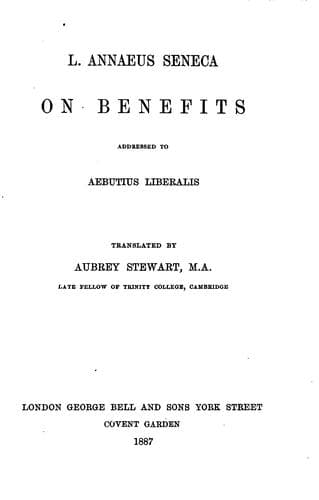
L. Annaeus Seneca on BenefitsSeneca, Lucius Annaeus
Philosophy
L. Annaeus Seneca on Benefits
Seneca, Lucius Annaeus
Benevolence; Classical literature; Conduct of life; Essays
giver, since God cannot hope to receive any advantages from us, there is
no cause why God should give anything.
IV. I know what answer may be made to this. "True; therefore God does
not bestow benefits, but, free from care and unmindful of us, He
turns away from our world and either does something else, or else does
nothing, which Epicurus thought the greatest possible happiness, and
He is not affected either by benefits or by injuries." The man who says
this cannot surely hear the voices of worshippers, and of those who all
around him are raising their hands to heaven and praying for the success
both of their private affairs and those of the state; which certainly
would not be the case, all men would not agree in this madness of
appealing to deaf and helpless gods, unless we knew that their benefits
are sometimes bestowed upon us unasked, sometimes in answer to our
prayers, and that they give us both great and seasonable gifts, which
shield us from the most terrible dangers. Who is there so poor, so
uncared for, born to sorrow by so unkind a fate, as never to have felt
the vast generosity of the Gods? Look even at those who complain and are
discontented with their lot; you will find that they are not altogether
without a share in the bounty of heaven, that there is no one upon whom
something has not been shed from that most gracious fount. Is the gift
which is bestowed upon all alike, at their birth, not enough? However
unequally the blessings of after life may be dealt out to us, did nature
give us too little when she gave us herself?
V. It is said, "God does not bestow benefits." Whence, then, comes all
that you possess, that you give or refuse to give, that you hoard or
steal? whence come these innumerable delights of our eyes, our ears, and
our minds? whence the plenty which provides us even with luxury--for it
is not our bare necessities alone against which provision is made;
we are loved so much as actually to be pampered--whence so many trees
bearing various fruits, so many wholesome herbs, so many different sorts
of food distributed throughout the year, so that even the slothful may
find sustenance in the chance produce of the earth? Then, too, whence
come the living creatures of all kinds, some inhabiting the dry land,
others the waters, others alighting from the sky, that every part of
nature may pay us some tribute; the rivers which encircle our meadows
with most beauteous bends, the others which afford a passage to merchant
fleets as they flow on, wide and navigable, some of which in summer
time are subject to extraordinary overflowings in order that lands lying
parched under a glowing sun may suddenly be watered by the rush of a
midsummer torrent?
What of the fountains of medicinal waters? What of the bursting forth of
warm waters upon the seashore itself? Shall I
Public-domain text, read in full here on John Shaqi.
Reviews
Reviews
No reviews yet
Be the first to share your thoughts on this work.
Elsewhere in the archive
Join the Discussion
Join the discussion
Sign in to leave a comment or review.
Sign InorCreate an account