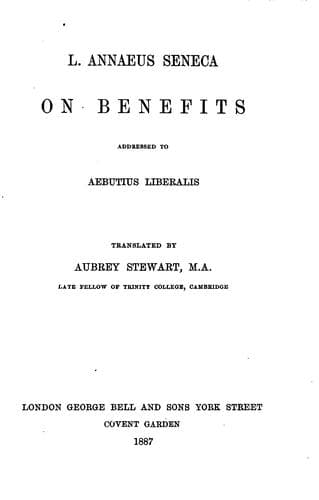
L. Annaeus Seneca on BenefitsSeneca, Lucius Annaeus
Philosophy
L. Annaeus Seneca on Benefits
Seneca, Lucius Annaeus
Benevolence; Classical literature; Conduct of life; Essays
II. In this part of the subject we oppose the Epicureans, an effeminate
and dreamy sect who philosophize in their own paradise, amongst whom
virtue is the handmaid of pleasures, obeys them, is subject to them,
and regards them as superior to itself. You say, "there is no pleasure
without virtue." But wherefore is it superior to virtue? Do you imagine
that the matter in dispute between them is merely one of precedence?
Nay, it is virtue itself and its powers which are in question. It cannot
be virtue if it can follow; the place of virtue is first, she ought to
lead, to command, to stand in the highest rank; you bid her look for a
cue to follow. "What," asks our opponent, "does that matter to you? I
also declare that happiness is impossible without virtue. Without virtue
I disapprove of and condemn the very pleasures which I pursue, and to
which I have surrendered myself. The only matter in dispute is this,
whether virtue be the cause of the highest good, or whether it be itself
the highest good." Do you suppose, though this be the only point in
question, that it is a mere matter of precedence? It is a confusion and
obvious blindness to prefer the last to the first. I am not angry at
virtue being placed below pleasure, but at her being mixed up at all
with pleasure, which she despises, whose enemy she is, and from which
she separates herself as far as possible, being more at home with labour
and sorrow, which are manly troubles, than with your womanish good
things.
III. It was necessary to insert this argument, my Liberalis, because
it is the part of virtue to bestow those benefits which we are now
discussing, and it is most disgraceful to bestow benefits for any other
purpose than that they should be free gifts. If we give with the hope of
receiving a return, we should give to the richest men, not to the most
deserving: whereas we prefer a virtuous poor man to an unmannerly rich
one. That is not a benefit, which takes into consideration the fortune
of the receiver. Moreover, if our only motive for benefiting others was
our own advantage, those who could most easily distribute benefits, such
as rich and powerful men, or kings, and persons who do not stand in need
of the help of others, ought never to do so at all; the gods would
not bestow upon us the countless blessings which they pour upon us
unceasingly by night and by day, for their own nature suffices them in
all respects, and renders them complete, safe, and beyond the reach of
harm; they will, therefore, never bestow a benefit upon any one, if self
and self interest be the only cause for the bestowal of benefits. To
take thought, not where your benefit will be best bestowed, but where
it may be most profitably placed at interest, from whence you will most
easily get it back, is not bestowal of benefits, but usury. Now the gods
have nothing to do with usury; it follows, therefore, that they cannot
be liberal; for if the only reason for giving is the advantage of the
Public-domain text, read in full here on John Shaqi.
Reviews
Reviews
No reviews yet
Be the first to share your thoughts on this work.
Elsewhere in the archive
Join the Discussion
Join the discussion
Sign in to leave a comment or review.
Sign InorCreate an account