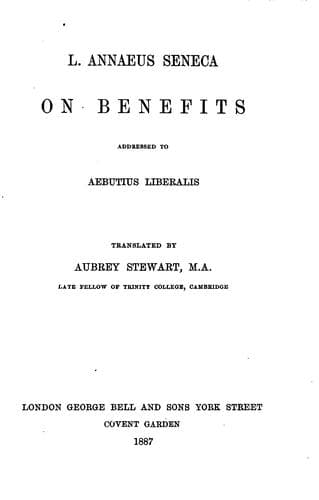
L. Annaeus Seneca on BenefitsSeneca, Lucius Annaeus
Philosophy
L. Annaeus Seneca on Benefits
Seneca, Lucius Annaeus
Benevolence; Classical literature; Conduct of life; Essays
The true God is he who has placed, not a few oxen, but all the herds on
their pastures throughout the world; who furnishes food to the flocks
wherever they wander; who has ordained the alternation of summer and
winter pasturage, and has taught us not merely to play upon a reed, and
to reduce to some order a rustic and artless song, but who has invented
so many arts and varieties of voice, so many notes to make music,
some with our own breath, some with instruments. You cannot call our
inventions our own any more than you call our growth our own, or the
various bodily functions which correspond to each stage of our lives; at
one time comes the loss of childhood's teeth, at another, when our age
is advancing and growing into robuster manhood, puberty and the last
wisdom-tooth marks the end of our youth. "We have implanted in us the
seeds of all ages, of all arts, and God our master brings forth our
intellects from obscurity."
VII. "Nature," says my opponent, "gives me all this." Do you not
perceive when you say this that you merely speak of God under another
name? for what is nature but God and divine reason, which pervades the
universe and all its parts? You may address the author of our world
by as many different titles as you please; you may rightly call him
Jupiter, Best and Greatest, and the Thunderer, or the Stayer, so called,
not because, as the historians tell us, he stayed the flight of the
Roman army in answer to the prayer of Romulus, but because all things
continue in their stay through his goodness. If you were to call this
same personage Fate, you would not lie; for since fate is nothing more
than a connected chain of causes, he is the first cause of all upon
which all the rest depend. You will also be right in applying to him any
names that you please which express supernatural strength and power: he
may have as many titles as he has attributes.
Public-domain text, read in full here on John Shaqi.
Reviews
Reviews
No reviews yet
Be the first to share your thoughts on this work.
Elsewhere in the archive
Join the Discussion
Join the discussion
Sign in to leave a comment or review.
Sign InorCreate an account